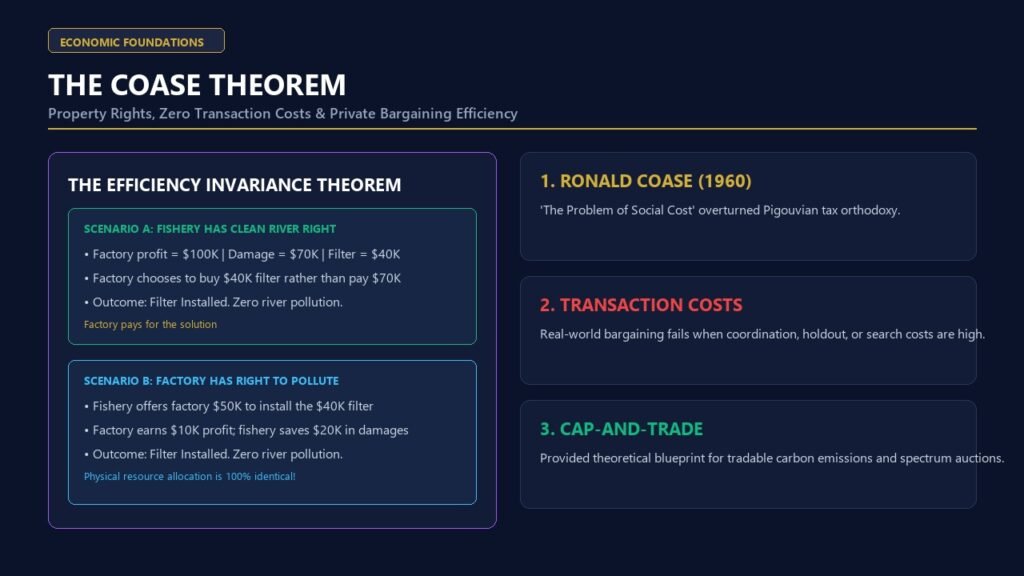
Executive Definition: The Coase theorem explained simply is a groundbreaking proposition in law and microeconomics asserting that when property rights are clearly defined and private transaction costs are zero, affected economic parties will bargain with one another to reach a Pareto-efficient allocation of resources, regardless of which party is originally assigned the legal property right. Formulated by Nobel laureate Ronald Coase in his 1960 paper “The Problem of Social Cost,” the theorem fundamentally challenged the classical Pigouvian view that government taxes or regulations are mandatory to correct environmental pollution and external spillovers.
For more than half a century, the dominant economic response to negative externalities—such as industrial smoke billowing over residential neighborhoods or chemical runoff spoiling fisheries—was automatic state intervention: levy a tax, impose a fine, or shut down the offending factory. However, having the Coase theorem explained through legal entitlements, bilateral bargaining, and institutional frictions reveals that the root cause of market failure is not greed or production spillovers, but the absence of clearly defined property rights and the presence of prohibitive transaction costs. Understanding this mechanism is vital for environmental economists, regulatory designers, and antitrust scholars.
Table of Contents
- 1. Intellectual Origins: Arthur Pigou’s Taxes vs. Ronald Coase’s 1960 Revolution
- 2. The Reciprocal Nature of Externalities: Rethinking Harm
- 3. The Two Absolute Prerequisites of the Coase Theorem
- 4. Step-by-Step Worked Numerical Example: The Factory and The Fishery
- 5. The Efficiency Invariance vs. Wealth Distribution Divergence
- 6. The Tyranny of Transaction Costs: Why Coasean Bargaining Fails in Practice
- 7. Modern Real-World Applications: Cap-and-Trade and Spectrum Auctions
- 8. Comparative Matrix: Coasean Bargaining vs. Pigouvian Taxes vs. Command Regulation
- 9. Frequently Asked Questions (FAQ)
- 10. Authoritative References & Primary Sources
1. Intellectual Origins: Arthur Pigou’s Taxes vs. Ronald Coase’s 1960 Revolution
In 1920, Cambridge economist Arthur Cecil Pigou published The Economics of Welfare, establishing the orthodoxy of environmental economics. Pigou argued that when a factory emits toxic soot, a divergence emerges between private production costs and social costs. Because the factory owner does not pay for clean air, the market produces an excessive, socially inefficient volume of pollution. Pigou’s solution was simple: the state must step in and levy a “Pigouvian tax” equal to the marginal external damage to internalize the externality.
Four decades later, Ronald Coase—then at the University of Virginia and later the University of Chicago Law School—published “The Problem of Social Cost” in the Journal of Law and Economics (1960). Coase delivered an intellectual shock to the economics profession by proving that under frictionless conditions, the market does not need state bureaucrats to set taxes or determine optimal pollution levels; self-interested private negotiations will discover the socially optimal outcome automatically.
2. The Reciprocal Nature of Externalities: Rethinking Harm
Coase began with a radical philosophical shift: externalities are not unidirectional acts of harm, but fundamentally reciprocal relationships. In Coase’s famous phrasing:
“The traditional approach has tended to obscure the nature of the choice that has to be made. The question is commonly thought of as one in which A inflicts harm on B and what has to be decided is: how should we restrain A? But this is wrong. We are dealing with a problem of a reciprocal nature. To avoid the harm to B would be to inflict harm on A. The real question that has to be decided is: should A be allowed to harm B or should B be allowed to harm A?”
Consider a confectionery shop whose pounding machinery disturbs a physician’s consulting room next door (the famous English legal case of Sturges v. Bridgman). It is easy to view the confectioner as the sole wrongdoer. But if the law shuts down the confectioner, it inflicts economic destruction on the confectioner to benefit the doctor. The harm only exists because both the confectioner and the doctor chose to operate in adjacent spaces. Society’s goal should not be the moral elimination of harm, but the maximization of total economic value.
3. The Two Absolute Prerequisites of the Coase Theorem
The Coase Theorem (named and formalized by George Stigler in 1966) relies on two vital conditions:
- 1. Clearly Defined and Enforceable Property Rights: The legal system must unambiguously assign who owns the disputed resource. Does the factory have the legal right to emit smoke into the atmosphere, or do the surrounding residents have the legal right to unpolluted air? The identity of the entitlement holder does not affect the ultimate resource allocation, but the entitlement must be clear and legally enforceable.
- 2. Zero (or Negligible) Transaction Costs: The parties must be able to identify one another, negotiate freely, draft contracts, exchange monetary payments, and monitor compliance without incurring significant expenses.
4. Step-by-Step Worked Numerical Example: The Factory and The Fishery
To see the mathematical beauty of the theorem, consider a chemical factory operating upstream from a commercial fishery on a pristine river:
- The factory earns a profit of $100,000 per year by dumping chemical waste into the river.
- Installing an advanced catalytic filtration system costs $40,000 per year, completely eliminating the waste.
- The chemical runoff pollutes the river, inflicting $70,000 per year in lost catch value on the downstream fishery.
The Socially Efficient Allocation:
Social cost of unmitigated pollution = $-\$70,000$. Cost of prevention = $-\$40,000$. Because the cost of prevention ($40,000) is substantially lower than the environmental damage ($70,000), society’s optimal outcome is for the factory to install the filter (net social surplus increases by $\$70,000 – \$40,000 = \$30,000$).
Now, let us examine two opposing legal rulings under zero transaction costs:
Case 1: The Court Grants Property Rights to the Fishery (Clean Water Entitlement)
The fishery has the legal right to an unpolluted river. The factory cannot dump waste unless the fishery agrees. The factory could try to compensate the fishery to accept the waste, but the fishery demands at least $\$70,000$. Because installing the filter costs only $\$40,000$, the profit-maximizing factory owner chooses to install the filter rather than pay $\$70,000$. Result: Filter installed. Zero pollution.
Case 2: The Court Grants Property Rights to the Factory (Right to Pollute Entitlement)
The factory has the legal right to dump chemical waste without liability. The fishery faces $\$70,000$ in damages. Rather than suffering the loss, the fishery owner approaches the factory and offers a bribe: “We will pay you $50,000 per year if you install the $40,000 filter.”
The factory owner accepts: installing the filter costs $\$40,000$, netting a $\$10,000$ pure profit on the $\$50,000$ payment. The fishery is delighted: paying $\$50,000$ saves it from $\$70,000$ in damages, leaving it $\$20,000$ better off. Result: Filter installed. Zero pollution.
The Coasean Invariance: Regardless of whether the court favored the polluting factory or the clean fishery, the physical economic outcome was identical: the filter was installed, and the river was saved!
5. The Efficiency Invariance vs. Wealth Distribution Divergence
While the physical resource allocation is invariant to legal entitlement, the distribution of wealth shifts dramatically:
- Under Fishery Rights, the factory pays $\$40,000$ for the filter. Factory net profit = $\$60,000$. Fishery net profit = Full baseline earnings.
- Under Factory Rights, the fishery pays $\$50,000$ to the factory. Factory net profit = $\$100,000 – \$40,000 + \$50,000 = \$110,000$. Fishery net profit = Baseline earnings minus $\$50,000$.
The law determines who pays whom (equity and justice), but market forces determine what actually gets produced (efficiency).
6. The Tyranny of Transaction Costs: Why Coasean Bargaining Fails in Practice
Coase did not write his 1960 paper to argue that real-world markets are frictionless; rather, he intended to demonstrate that transaction costs are the central reason why externalities persist unresolved. In modern economies, transaction costs are massive:
- The Free Rider Problem (Large Numbers): If a coal power plant pollutes the air breathed by 500,000 residents, each suffering $10 in damage, private bargaining collapses. Organizing 500,000 people to collect a $2 million bribe is impossible because individual residents refuse to contribute, hoping their neighbors will pay while they enjoy clean air for free.
- The Holdout Problem: If an airport needs to acquire noise easements from 200 homeowners, the final homeowner can demand an extortionate payout ($1 million) knowing that without their signature, the runway cannot open.
- Asymmetric Information & Legal Expenses: Calculating the true economic damage of microplastics or smog requires expensive scientific studies and litigation. When legal fees exceed the value of the bargaining surplus, private negotiations evaporate.
Coase’s true insight was that when transaction costs prevent private bargaining, the legal system and government regulation must assign liability to the party that can avoid the harm at the lowest cost (the Cheapest Cost Avoider principle).
7. Modern Real-World Applications: Cap-and-Trade and Spectrum Auctions
The Coase Theorem provided the intellectual blueprint for some of the most successful market-based environmental and regulatory innovations of the late 20th and early 21st centuries:
- Cap-and-Trade Emissions Markets: During the 1990 Clean Air Act amendments in the US and the European Union’s Emissions Trading System (EU ETS), governments abandoned rigid command regulations. Instead, they defined enforceable property rights in the form of tradable pollution permits. Clean firms that cut emissions cheaply sold surplus permits to dirty firms, achieving massive reductions in acid rain and greenhouse gases at minimal economic cost.
- FCC Spectrum Auctions: Prior to 1994, the US Federal Communications Commission assigned radio and telecommunications spectrum through bureaucratic hearings (“beauty contests”). Following Coase’s earlier 1959 critique, the FCC began auctioning spectrum property rights, allowing mobile telecom giants to trade frequencies to their highest-valued use.
To examine foundational market mechanics, see our comprehensive guide on how supply and demand determine equilibrium prices and review how institutions impact living standards in our analysis of institutional economics.
8. Comparative Matrix: Coasean Bargaining vs. Pigouvian Taxes vs. Command Regulation
| Regulatory Approach | Mechanism of Action | Information Burden on State | Optimal Context |
|---|---|---|---|
| Coasean Private Bargaining | Assign clear property rights; let affected parties negotiate | Extremely low; market participants discover values | Small number of affected parties; low transaction costs |
| Pigouvian Corrective Tax | State sets a per-unit tax equal to marginal external damage | High; government must measure exact monetary harm | Widespread pollution across millions (carbon tax, fuel duties) |
| Command-and-Control Regulation | State mandates legal emission caps or required technologies | Very high; regulators dictate corporate engineering | Extreme hazards (radioactive waste, toxic heavy metals) |
9. Frequently Asked Questions (FAQ)
What is the Coase theorem in simple terms?
The Coase theorem says that if property rights are clearly assigned and it costs nothing to negotiate, people will bargain with each other to solve pollution and other spillover problems efficiently, regardless of who was originally given the legal right.
Does the initial assignment of property rights matter under the Coase theorem?
For economic efficiency, it does not matter: the same optimal level of pollution and production will occur. However, for wealth distribution, it matters immensely because the party that owns the legal right receives financial compensation from the other party.
Why doesn’t the Coase theorem solve global climate change?
Because global climate change involves billions of people, multiple generations, and complex international borders. The transaction costs, free rider problems, and legal enforcement costs are astronomically high, preventing direct private negotiations.
What is the difference between a Pigouvian tax and the Coase theorem?
A Pigouvian tax uses government coercion to levy a tax equal to the damage of an externality. The Coase theorem relies on private property rights and voluntary contracts, removing the need for state-calculated tax rates.
What did Ronald Coase win the Nobel Prize for?
Ronald Coase won the 1991 Nobel Memorial Prize in Economic Sciences for his discovery and clarification of the significance of transaction costs and property rights for the institutional structure and functioning of the economy.
10. Authoritative References & Primary Sources
- Coase, Ronald H. (1960). “The Problem of Social Cost.” Journal of Law and Economics, 3, 1–44.
- Coase, Ronald H. (1959). “The Federal Communications Commission.” Journal of Law and Economics, 2, 1–40.
- Pigou, Arthur C. (1920). The Economics of Welfare. Macmillan and Co.
- Stigler, George J. (1966). The Theory of Price (3rd Edition). Macmillan.
- Ostrom, Elinor. (1990). Governing the Commons: The Evolution of Institutions for Collective Action. Cambridge University Press.