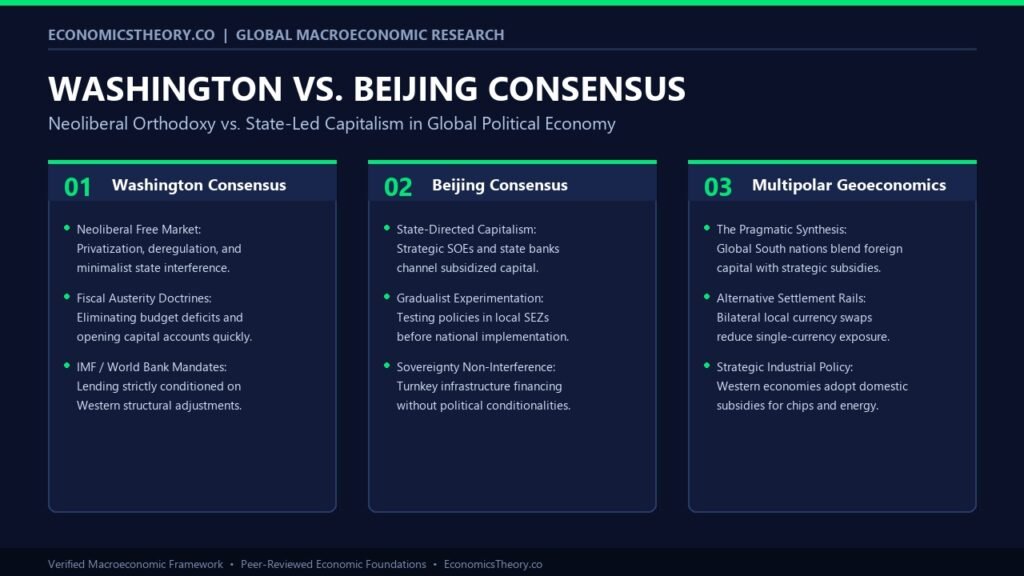
Executive Definition: The debate over the Washington Consensus vs Beijing Consensus represents the defining ideological struggle in modern global political economy. Formulated by John Williamson in 1989, the Washington Consensus prescribes a neoliberal development model grounded in free markets, privatization, fiscal austerity, trade liberalization, and minimal state intervention. In stark contrast, the Beijing Consensus—coined by Joshua Cooper Ramo in 2004—articulates an alternative development pathway characterized by authoritarian state-directed capitalism, strategic industrial subsidies, gradualist experimentation, and the prioritization of national sovereignty over Western institutional conditionality.
For decades following the collapse of the Soviet Union, the Western free-market orthodoxy was hailed as the undisputed end of history. However, catastrophic structural adjustment failures across Latin America and Sub-Saharan Africa, paired with China’s unprecedented historic ascent—lifting over 800 million citizens out of absolute poverty—shattered the universal applicability of Western neoliberal prescriptions. Having the Washington Consensus vs Beijing Consensus evaluated across macro-financial stability, capital account controls, and industrial policy reveals how developing nations increasingly navigate a fragmented, multipolar global economy. In this comprehensive critique, we compare the ten core tenets of each paradigm, evaluate empirical track records, analyze the Rodrik Political Trilemma, and forecast the emergent synthesis defining 21st-century geoeconomics.
Table of Contents
- 1. The Intellectual Foundations of the Washington Consensus (1989)
- 2. The Emergence of the Beijing Consensus: Pragmatism over Dogma
- 3. Core Structural Clashes: Tenets, Levers, and Philosophical Divergence
- 4. Dani Rodrik’s Political Trilemma of the World Economy
- 5. The Empirical Scorecard: Latin American Shock Therapy vs. East Asian Gradualism
- 6. The Rise of the Global South and Institutional Fragmentation
- 7. Comparative Framework: Washington Consensus vs. Beijing Consensus Matrix
- 8. Frequently Asked Questions (FAQ)
- 9. Authoritative References & Academic Citations
1. The Intellectual Foundations of the Washington Consensus (1989)
When British economist John Williamson coined the term “Washington Consensus” in 1989, he summarized ten specific policy recommendations that Washington-based institutions—the International Monetary Fund (IMF), the World Bank, and the U.S. Department of the Treasury—believed were essential for debt-burdened Latin American economies recovering from the 1980s sovereign debt crisis. These ten foundational tenets were:
- Fiscal Discipline: Eliminating large operational budget deficits to tame hyperinflation and sovereign default risks.
- Public Expenditure Redirection: Diverting subsidies away from broad consumption toward high-return primary education, healthcare, and basic infrastructure.
- Tax Reform: Broadening the domestic tax base while cutting high marginal income and corporate tax rates to stimulate investment.
- Market-Determined Interest Rates: Abolishing state interest rate caps to ensure positive real returns on capital and prevent credit rationing.
- Competitive Exchange Rates: Abandoning rigid overvalued currency pegs in favor of export-supporting equilibrium market rates.
- Trade Liberalization: Replacing discretionary import quotas and protective tariffs with low, uniform customs duties to integrate into global supply chains.
- Foreign Direct Investment (FDI) Openness: Abolishing legal restrictions on foreign corporate capital inflows and technology transfer.
- Privatization: Liquidating loss-making State-Owned Enterprises (SOEs) to eliminate fiscal drains and unleash private market efficiencies.
- Deregulation: Dismantling bureaucratic licensing barriers and state price controls that choke domestic business formation.
- Property Rights Legal Security: Securing contract enforcement, independent judiciaries, and formal land titling.
2. The Emergence of the Beijing Consensus: Pragmatism over Dogma
While the Washington Consensus treated economic development as a universal, one-size-fits-all legalistic blueprint, China’s transformation under Deng Xiaoping followed an entirely different logic: “Crossing the river by feeling the stones” (摸着石头过河). In 2004, political analyst Joshua Cooper Ramo codified this approach as the Beijing Consensus, identifying three core conceptual pillars:
- 1. Radical Innovation and Adaptation: Rejection of standardized Western textbook orthodoxy. Policies are tested locally in pilot Special Economic Zones (SEZs)—such as Shenzhen in 1980—before nationwide legislative rollout.
- 2. Chaotic Friction Management & Quality of Life: Economic expansion must not sacrifice political stability or social cohesion; market forces are actively guided to prevent systemic inequality shocks.
- 3. Fierce National Self-Determination: Absolute refusal to accept external ideological governance, Western political conditionality, or foreign control over domestic financial commanding heights.
Under this state-capitalist model, the ruling state retains strategic ownership of core sectors—including state-owned commercial banks, electric utilities, civil aviation, and telecommunications—while unleashing intense market competition among private enterprises in consumer manufacturing, digital platforms, and export logistics.
3. Core Structural Clashes: Tenets, Levers, and Philosophical Divergence
The philosophical divide between the two paradigms centers on three fundamental macroeconomic dimensions:
A. Capital Controls vs. Open Financial Accounts
The Washington Consensus insisted on rapid capital account liberalization, encouraging developing nations to open their borders to foreign portfolio hot money. When global market sentiment turned, sudden capital flight triggered catastrophic currency collapses (as observed during the 1997 Asian Financial Crisis in Thailand, Indonesia, and South Korea). In contrast, the Beijing model maintains strict capital controls and currency management, insulating domestic lending systems from foreign speculative runs and preserving sovereign monetary policy autonomy.
B. Industrial Policy vs. Market Neutrality
Neoliberal doctrine argues that governments cannot “pick winners” and must maintain strict market neutrality. The Beijing model rejects market neutrality, utilizing state policy banks (such as China Development Bank) to channel hundreds of billions of dollars in subsidized credit into strategic industrial frontiers—such as electric vehicles (EVs), photovoltaic solar cells, lithium-ion battery chemistry, and high-speed rail networks—deliberately driving down global cost curves and capturing international market share.
C. Institutional Conditionality
When the IMF or World Bank lends to developing sovereigns, financing is tied to severe structural adjustment programs (fiscal austerity, public-sector layoffs, utility privatization, and political restructuring). Chinese development lending (through bilateral facilities and the Belt and Road Initiative) emphasizes non-interference in domestic political systems, delivering turnkey physical infrastructure in exchange for long-term commodity supply agreements and asset collateral.
4. Dani Rodrik’s Political Trilemma of the World Economy
To understand the structural unsustainability of pure neoliberal globalization, Harvard political economist Dani Rodrik formulated the Political Trilemma of the World Economy. According to Rodrik, an economy cannot simultaneously maintain all three of the following nodes:
- 1. Hyperglobalization: Complete elimination of international trade and financial friction.
- 2. National Sovereignty: Independent domestic lawmaking, industrial subsidies, and tax policies.
- 3. Democratic Politics: National political responsiveness to domestic voter welfare and wage protection.
The Washington Consensus prioritized Hyperglobalization and National Sovereignty, forcing domestic democratic policies to surrender to international capital markets (the “Golden Straitjacket”). When citizens protested austerity, governments had no policy space to respond. The Beijing Consensus, by contrast, rejects hyperglobalization and Western liberal democracy, pairing deep trade integration with strict state sovereignty and domestic economic control.
5. The Empirical Scorecard: Latin American Shock Therapy vs. East Asian Gradualism
The historical results of both paradigms have been rigorously scrutinized by academic economists such as Joseph Stiglitz and Dani Rodrik:
- The Neoliberal Disappointment: In the 1990s, Argentina followed Washington Consensus prescriptions to the letter: privatizing state utilities, fixing its peso to the U.S. dollar, and deregulating cross-border trade. By 2001, Argentina suffered a catastrophic debt default, social riots, and GDP contraction exceeding 20%. Across Sub-Saharan Africa and Latin America, the “lost decades” of the 1980s and 1990s saw per capita growth stagnate under heavy fiscal austerity.
- The East Asian Synthesis: China, Vietnam, and previously Japan and South Korea achieved the fastest sustained economic expansions in human history not by blind adherence to laissez-faire, but through hybrid models: high export orientation combined with extensive state coordination, protective tariffs during infant industry phases, and heavily managed currencies.
6. The Rise of the Global South and Institutional Fragmentation
Today, the global economic architecture is no longer unipolar. Emerging economies across the Global South—including India, Brazil, Indonesia, and Saudi Arabia—refuse to choose dogmatically between Washington or Beijing. Instead, they pursue a pragmatic “multi-aligned economic statecraft,” adopting Western legal standards and foreign direct investment where beneficial, while simultaneously utilizing state subsidies (such as India’s Production-Linked Incentive schemes), national sovereign wealth funds, and alternative payment architectures (such as local currency bilateral settlements) pioneered by the Beijing model.
7. Comparative Framework: Washington Consensus vs. Beijing Consensus Matrix
| Policy Dimension | The Washington Consensus | The Beijing Consensus |
|---|---|---|
| Economic Philosophy | Neoliberal market fundamentalism | State-directed capitalism & pragmatism |
| Role of the State | Minimalist referee; Enforce property rights | Strategic architect; Direct capital & industry |
| Reform Methodology | Rapid “Shock Therapy” privatization | Gradual experimentation & pilot zones |
| Capital Account | Full capital account liberalization | Managed capital controls & FX reserves |
| Lending Conditionality | Strict structural austerity & governance mandates | Physical infrastructure focus; No political strings |
8. Frequently Asked Questions (FAQ)
Q1: Who coined the terms Washington Consensus and Beijing Consensus?
British economist John Williamson formulated the Washington Consensus in 1989. The term Beijing Consensus was coined in 2004 by Joshua Cooper Ramo, a former foreign editor of Time magazine and member of the World Economic Forum.
Q2: Why did the Washington Consensus lose credibility among developing nations?
The model lost credibility because its strict austerity programs, rapid trade opening, and financial deregulation frequently resulted in rising income inequality, deindustrialization, and vulnerability to speculative financial crises, most notably in Latin America during the late 1990s.
Q3: Can other developing nations successfully copy the Beijing Consensus?
Directly replicating the Beijing Consensus is exceptionally difficult because it relies on unique historical preconditions: massive state capacity, a disciplined one-party political apparatus, an enormous domestic consumer market, and high national savings rates that most developing countries do not possess.
Q4: Is the United States itself moving toward state capitalism?
Yes. Through landmark industrial policy legislation such as the CHIPS and Science Act and the Inflation Reduction Act, the United States and Western economies have increasingly embraced state subsidies, domestic content rules, and national security supply chain interventions, effectively borrowing key aspects of state capitalism.
9. Authoritative References & Academic Citations
- Williamson, J. (1990): “What Washington Means by Policy Reform”, in Latin American Adjustment: How Much Has Happened? Institute for International Economics.
- Ramo, J. C. (2004): “The Beijing Consensus”, The Foreign Policy Centre, London.
- Stiglitz, J. E. (2002): “Globalization and Its Discontents”, W. W. Norton & Company.
- Rodrik, D. (2006): “Goodbye Washington Consensus, Hello Washington Confusion? A Review of the World Bank’s Economic Growth in the 1990s”, Journal of Economic Literature, 44(4), 973-987.
- Rodrik, D. (2011): “The Globalization Paradox: Democracy and the Future of the World Economy”, W. W. Norton & Company.