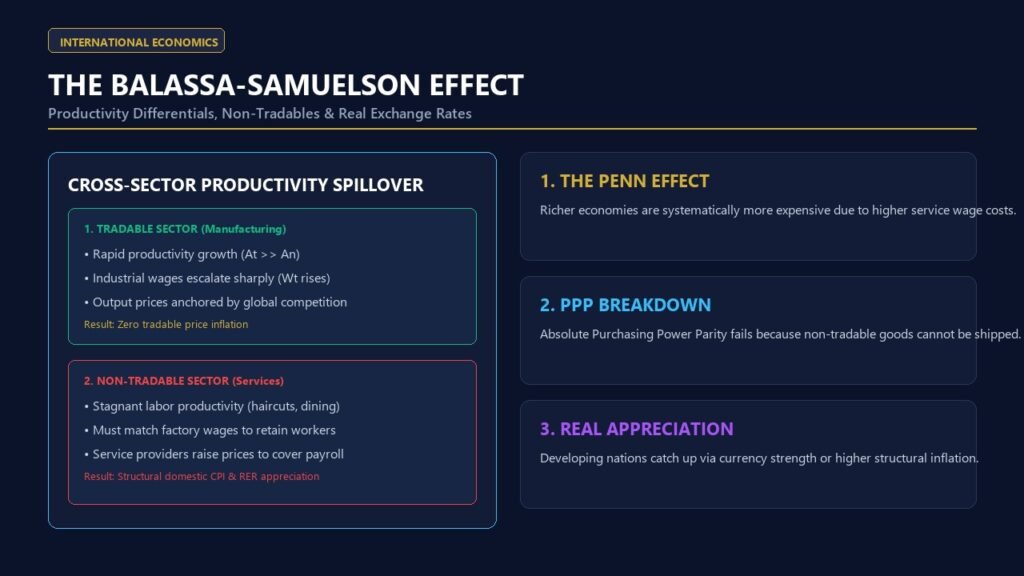
Executive Definition: The Balassa Samuelson effect explained simply is an international macroeconomic proposition demonstrating why countries with higher productivity growth in tradable goods experience higher domestic service prices and structural real exchange rate appreciation. Formulated independently in 1964 by Bela Balassa and Paul Samuelson, the framework explains why absolute Purchasing Power Parity (PPP) systematically fails between developing and advanced economies, causing price levels in lower-income countries to appear artificially inexpensive when measured at market exchange rates.
For international investors, sovereign fund allocators, and foreign exchange strategists, evaluating cross-border purchasing power requires understanding why a haircut in Tokyo or New York costs four times more than the identical haircut in Mumbai or Hanoi. The answer does not lie in barber incompetence or monetary debasement, but in the structural dynamics of cross-sector labor market equilibrium. Having the Balassa Samuelson effect explained from its mathematical foundations to real-world currency valuation provides the essential lens for assessing currency undervaluation, long-term real exchange rate trajectories, and global living standard comparisons.
Table of Contents
- 1. Theoretical Foundations: Why Absolute PPP Fails Empirically
- 2. The Two-Sector Analytical Framework: Tradable vs. Non-Tradable Goods
- 3. Formal Mathematical Derivation of the Balassa-Samuelson Model
- 4. The Domestic Wage Equalization and Cost-Push Spillover Channel
- 5. Real Exchange Rate Appreciation in Rapidly Catching-Up Economies
- 6. Step-by-Step Worked Numerical Example
- 7. Empirical Evidence, Cross-Country Realities, and The “Penn Effect”
- 8. Implications for Central Banks, Inflation Targeting, and Currency Pegs
- 9. Comparative Matrix: Tradable vs. Non-Tradable Sector Dynamics
- 10. Frequently Asked Questions (FAQ)
- 11. Authoritative References & Primary Sources
1. Theoretical Foundations: Why Absolute PPP Fails Empirically
The classical theory of Purchasing Power Parity (PPP), derived from the Law of One Price, asserts that in the absence of transport costs and trade barriers, identical baskets of goods should cost the exact same amount when converted into a common currency at the prevailing nominal exchange rate ($E$):
P = E \cdot P^*
Where $P$ is the domestic aggregate price level, $P^*$ is the foreign aggregate price level, and $E$ is the nominal exchange rate (units of domestic currency per unit of foreign currency). If PPP held perfectly across all goods, the real exchange rate ($RER = E \cdot P^* / P$) would perpetually equal 1, and living costs across nations would converge.
Yet, empirical reality comprehensively repudiates absolute PPP. Travelers from developed nations routinely observe that basic consumer services—restaurant dining, housing rentals, personal grooming, and domestic transport—are dramatically cheaper in emerging markets. This systematic divergence, termed the Penn Effect (documented by Irving Kravis, Alan Heston, and Robert Summers in the Penn World Table), reveals that national price levels correlate positively with per capita income: richer countries are systematically more expensive than poorer countries.
2. The Two-Sector Analytical Framework: Tradable vs. Non-Tradable Goods
In 1964, Hungarian-American economist Bela Balassa and American Nobel laureate Paul Samuelson independently unlocked this puzzle by decomposing the aggregate economy into two distinct macroeconomic sectors:
- The Tradable Sector ($T$): Manufactured merchandise, industrial machinery, semiconductors, agricultural commodities, and digitized software. These goods face fierce international competition and can be transported across borders at low cost. Consequently, the Law of One Price holds tightly: $P_T = E \cdot P_T^*$. Productivity in this sector experiences rapid, capital-intensive technological growth through robotics, automated assembly lines, and global supply chains.
- The Non-Tradable Sector ($N$): Local services, personal care, education, healthcare, civil construction, and restaurant hospitality. These services cannot be physically shipped abroad (a patient in London cannot import an emergency appendectomy from Delhi). Because non-tradable goods are sheltered from direct foreign competition, their prices are determined entirely by domestic production costs—principally domestic wage rates. Furthermore, technological productivity gains in services are historically sluggish; cutting hair or teaching elementary mathematics takes roughly the same labor time today as it did a century ago.
3. Formal Mathematical Derivation of the Balassa-Samuelson Model
To formalize the mechanism, consider production functions where labor ($L$) is the sole variable input with sector-specific marginal productivities $A_T$ and $A_N$:
Y_T = A_T \cdot L_T \quad \text{and} \quad Y_N = A_N \cdot L_N
Under competitive profit-maximizing labor markets, firms hire workers until the nominal wage ($W$) equals the marginal revenue product of labor:
W_T = P_T \cdot A_T \implies P_T = \frac{W_T}{A_T}
W_N = P_N \cdot A_N \implies P_N = \frac{W_N}{A_N}
Domestic Labor Mobility Condition: Because workers can move freely between factories and service jobs within the same national border, wages must equalize across sectors ($W_T = W_N = W$):
W = P_T \cdot A_T = P_N \cdot A_N
Rearranging this identity yields the relative price of non-tradable goods as a direct function of relative sectoral productivities:
\frac{P_N}{P_T} = \frac{A_T}{A_N}
Taking logarithmic differentials ($\hat{x} = dx/x$), we obtain the core inflation differential equation between the service sector and the manufacturing sector:
\hat{P}_N – \hat{P}_T = \hat{A}_T – \hat{A}_N
This equation proves that whenever productivity growth in tradable goods exceeds productivity growth in non-tradable services ($\hat{A}_T > \hat{A}_N$), the relative price of services must rise ($\hat{P}_N > \hat{P}_T$).
4. The Domestic Wage Equalization and Cost-Push Spillover Channel
The transmission mechanism operates through domestic labor arbitrage:
- Tradable Productivity Surge: As an economy industrializes (e.g., South Korea in the 1980s, China in the 2000s, or India today), manufacturing plants adopt high-tech capital. Factory output per worker surges ($A_T \uparrow$).
- Industrial Wage Escalation: To retain skilled labor and reflect higher marginal revenue, manufacturing firms bid up industrial wages ($W_T \uparrow$). Because manufacturers compete globally, international market discipline prevents them from raising output prices ($P_T$ remains tied to global benchmarks).
- Cross-Sector Wage Contagion: Service providers—hospitals, schools, restaurants, and retail shops—now find their workforce being recruited by high-paying manufacturing and tech facilities. To prevent complete staff attrition, service employers must match industrial wages ($W_N \uparrow$).
- Cost-Push Service Inflation: Unlike manufacturing, service productivity ($A_N$) has barely budged (a dentist cannot clean teeth twice as fast without compromising medical safety). To absorb the higher payroll costs without going bankrupt, service providers must raise end-consumer prices ($P_N \uparrow$).
Consequently, the overall consumer price index ($CPI$), which is a weighted geometric mean of tradables and non-tradables ($P = P_T^\alpha P_N^{1-\alpha}$), experiences structural upward pressure driven entirely by domestic service cost escalation.
5. Real Exchange Rate Appreciation in Rapidly Catching-Up Economies
To observe how this alters international currency competitiveness, express the real exchange rate ($RER$) using overall consumer price indices:
\Delta \ln(RER) = (\hat{E} + \hat{P}^* – \hat{P}) = (1 – \alpha)\left[(\hat{A}_T^* – \hat{A}_N^*) – (\hat{A}_T – \hat{A}_N)\right]
When an emerging market catches up with an advanced nation, its tradable productivity growth typically dwarfs that of the developed economy ($(\hat{A}_T – \hat{A}_N) > (\hat{A}_T^* – \hat{A}_N^*)$). This forces the domestic price level ($P$) to rise faster than the foreign price level ($P^*$).
This inevitable real appreciation must manifest through one of two empirical pathways:
- Under a Floating Exchange Rate: The domestic nominal currency appreciates ($\hat{E} < 0$), making foreign goods cheaper while keeping domestic CPI inflation moderate.
- Under a Fixed or Pegged Exchange Rate: Because nominal appreciation is prohibited by central bank intervention, real appreciation forces its way through higher domestic inflation ($\hat{P} > \hat{P}^*$), creating structural consumer inflation differentials.
To explore how fixed vs floating currency choices interact with monetary autonomy, see our complete guide on the Impossible Trinity (Mundell-Fleming Trilemma) and review how external imbalances propagate through the balance of payments current account.
6. Step-by-Step Worked Numerical Example
Consider an emerging market economy (Economy $E$) and an advanced trading partner (Economy $A$):
- Sector weights: Tradables $\alpha = 0.50$, Non-Tradables $1 – \alpha = 0.50$.
- Economy $E$ (Emerging): Tradable productivity growth $\hat{A}_T = 6.0\%$, Non-Tradable growth $\hat{A}_N = 1.0\%$.
- Economy $A$ (Advanced): Tradable productivity growth $\hat{A}_T^* = 2.0\%$, Non-Tradable growth $\hat{A}_N^* = 1.0\%$.
- World tradable price inflation is anchored at $\hat{P}_T = \hat{P}_T^* = 0\%$.
Step 1: Calculate Service Price Inflation in Both Economies
\hat{P}_N^E = \hat{P}_T + (\hat{A}_T^E – \hat{A}_N^E) = 0\% + (6\% – 1\%) = +5.0\%
\hat{P}_N^A = \hat{P}_T^* + (\hat{A}_T^A – \hat{A}_N^A) = 0\% + (2\% – 1\%) = +1.0\%
Step 2: Calculate Overall CPI Inflation
\hat{P}_E = 0.5(0\%) + 0.5(5.0\%) = 2.5\%
\hat{P}_A = 0.5(0\%) + 0.5(1.0\%) = 0.5\%
Step 3: Determine Real Exchange Rate Appreciation
\text{Inflation Differential} = \hat{P}_E – \hat{P}_A = 2.5\% – 0.5\% = 2.0\%
If the nominal exchange rate remains constant, Economy $E$’s currency experiences an automatic 2.0% annual real exchange rate appreciation. This appreciation reflects genuine economic strength and productivity convergence rather than unanchored monetary policy.
7. Empirical Evidence, Cross-Country Realities, and The “Penn Effect”
Decades of empirical testing provide robust support for the core Balassa-Samuelson hypothesis, while highlighting critical institutional caveats:
- The Post-War Japanese Miracle: Between 1950 and 1980, Japan’s manufacturing sector expanded productivity at over 8% per year. Consequently, Japan experienced persistent real yen appreciation and higher domestic CPI inflation than the US, even while Japanese exporters captured dominant global market share in electronics and automobiles.
- Eurozone Accession Disparities: When Central and Eastern European nations (e.g., Poland, Slovakia, Czechia) integrated into the European Single Market, their manufacturing sectors attracted massive FDI. The resulting wage contagion forced domestic service inflation well above Germany’s, creating persistent inflation divergence inside the Eurozone currency union.
- China’s Managed Real Appreciation: For decades, critics accused China of artificially undervaluing the Renminbi. While China accumulated massive reserves to manage the nominal peg, the Balassa-Samuelson effect operated through rapid domestic wage inflation: Chinese urban factory wages rose more than tenfold between 2000 and 2020, significantly narrowing the price gap with the West in real terms.
8. Implications for Central Banks, Inflation Targeting, and Currency Pegs
Failing to account for the Balassa-Samuelson effect frequently leads central banks into disastrous monetary errors:
- Mistaking Structural Catch-up for Overheating: Developing nation central banks that pursue rigid Western-style 2% headline inflation targets may inadvertently crush their economies. If the Balassa-Samuelson effect naturally generates 2%–3% non-tradable service inflation, forcing headline CPI down to 2% requires engineering deflation in the tradable manufacturing sector through punishingly high interest rates.
- The Inevitability of Currency Realignment: Emerging markets attempting to maintain an undervalued nominal currency peg to subsidize exporters will inevitably face rising domestic inflation, property asset bubbles, and central bank sterilization costs. Real exchange rate appreciation cannot be permanently suppressed; it can only be diverted between nominal currency appreciation and domestic price inflation.
To analyze how central banks calibrate interest rate reactions to inflation and output gaps, explore our deep dive on the Taylor Rule framework.
9. Comparative Matrix: Tradable vs. Non-Tradable Sector Dynamics
| Economic Dimension | Tradable Goods Sector ($T$) | Non-Tradable Goods Sector ($N$) |
|---|---|---|
| Representative Industries | Automobiles, Electronics, Steel, Software, Commodities | Barbershops, Dining, Housing, Primary Healthcare, Domestic Transit |
| Price Determination | Law of One Price ($P_T = E \cdot P_T^*$) via global competition | Domestic wage costs and local demand ($P_N = W / A_N$) |
| Productivity Growth ($\hat{A}$) | High; rapid capital deepening and automation | Low to stagnant; labor-intensive personal service delivery |
| Wage Determinant | Directly tied to industrial marginal revenue product | Forced upward via domestic labor market arbitrage |
| Inflation Vulnerability | Anchored by international import competition | Structural upward drift as national per capita income expands |
10. Frequently Asked Questions (FAQ)
What is the Balassa-Samuelson effect in simple terms?
It is the economic rule showing that as a developing country becomes more productive in manufacturing and exporting goods, wages rise across the entire economy. Because local service businesses (like restaurants and haircuts) must pay these higher wages without major productivity gains, service prices surge, making the country more expensive in real terms.
Why does the Balassa-Samuelson effect cause Purchasing Power Parity (PPP) to fail?
Absolute PPP assumes all goods are freely traded internationally, equalizing prices everywhere. However, services cannot be traded across borders. Because service prices are tied to local wages, which depend on manufacturing productivity, high-income nations have much higher service prices, causing absolute PPP to fail.
What is the difference between the Penn Effect and the Balassa-Samuelson effect?
The Penn Effect is the empirical observation that price levels are higher in richer countries than in poorer countries. The Balassa-Samuelson effect is the theoretical and mathematical explanation that accounts for why the Penn Effect exists (productivity differentials between tradable and non-tradable sectors).
Does the Balassa-Samuelson effect harm an emerging country’s export competitiveness?
No. The real exchange rate appreciation is driven by superior productivity in the export sector itself. Because manufacturing output per worker is rising as fast as or faster than wages, unit labor costs in the export sector remain competitive even while the overall currency appreciates in real terms.
How should central banks in developing economies respond to the Balassa-Samuelson effect?
Central banks should accommodate the natural inflation differential by allowing either moderate nominal currency appreciation or slightly higher headline inflation targets (e.g., 4% instead of 2%), rather than choking off economic growth with excessive monetary tightening.
11. Authoritative References & Primary Sources
- Balassa, Bela. (1964). “The Purchasing-Power Parity Doctrine: A Reappraisal.” Journal of Political Economy, 72(6), 584–596.
- Samuelson, Paul A. (1964). “Theoretical Notes on Trade Problems.” The Review of Economics and Statistics, 46(2), 145–154.
- Kravis, Irving B., & Lipsey, Robert E. (1983). “Toward an Explanation of National Price Levels.” Princeton Studies in International Finance, No. 52.
- Rogoff, Kenneth. (1996). “The Purchasing Power Parity Puzzle.” Journal of Economic Literature, 34(2), 647–668.
- International Monetary Fund (IMF). (2023). “Productivity Catch-up and Real Exchange Rate Appreciation in Emerging Markets.” IMF Economic Review.