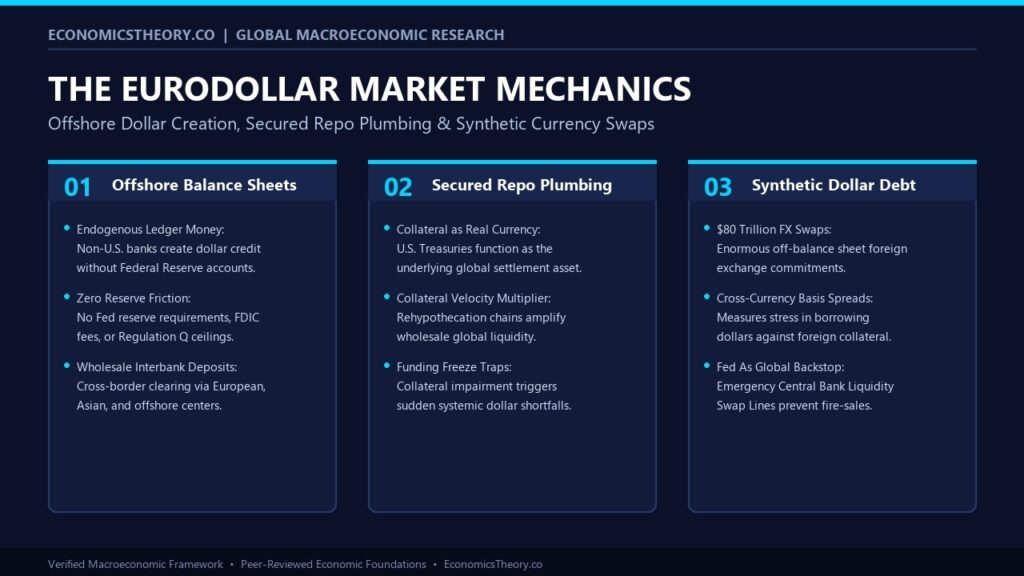
Executive Definition: The Eurodollar market explained simply refers to the vast, decentralized global wholesale network of U.S. dollar-denominated bank deposits and credit facilities held at financial institutions outside the direct regulatory jurisdiction of the United States. Despite its geographic name, Eurodollars have no relation to the European euro currency; they are dollar liabilities created, borrowed, and lent across London, Tokyo, Singapore, Zurich, and the Caribbean without reserve requirements, FDIC insurance, or direct Federal Reserve supervision.
When financial analysts track global dollar shortages or sudden liquidity freezes during crises, the epicenter is rarely domestic Wall Street retail branches; it is almost invariably the offshore shadow plumbing of the Eurodollar system. Having the Eurodollar market explained through balance sheet mechanics, secured interbank repo transactions, and FX swaps reveals how the true global reserve currency is not physical Federal Reserve paper notes, but an interconnected network of cross-border ledger entries. In this comprehensive guide, we dissect how offshore commercial banks create dollars endogenously, why the wholesale repo market replaced unsecured interbank lending, and how collateral shortages trigger systemic financial heart attacks.
Table of Contents
- 1. Historical Origins: Cold War Distrust to Global Offshore Hegemony
- 2. Endogenous Dollar Creation: How Foreign Banks Mint U.S. Purchasing Power
- 3. The Repo Plumbing: Pristine Collateral as Offshore Currency
- 4. FX Swaps and Synthetic Dollars: The $80 Trillion Off-Balance Sheet Debt
- 5. Why the Federal Reserve Struggles to Control Offshore Money Supply
- 6. Comparative Analysis: Domestic Fed Dollars vs. Offshore Eurodollars
- 7. Frequently Asked Questions (FAQ)
- 8. Authoritative References & Further Reading
1. Historical Origins: Cold War Distrust to Global Offshore Hegemony
The genesis of the Eurodollar market was not an American policy design, but a byproduct of Soviet geopolitical paranoia in the late 1950s. During the height of the Cold War, the Soviet Union and its satellite states accumulated substantial U.S. dollar balances from oil exports. Fearing that the U.S. government would freeze their accounts held in New York banks under national security directives, the Soviet state bank (Gosbank) transferred its dollar deposits to the Moscow Narodny Bank in London and the Banque Commerciale pour l’Europe du Nord in Paris (whose cable address was famously “EURBANK”).
These European institutions held U.S. dollars but operated entirely outside American regulatory constraints, such as Federal Reserve Regulation Q, which capped interest rates on domestic deposits. European and British banks quickly realized they could pay higher yields on dollar deposits and lend them out at competitive rates to global multinational corporations. Over the subsequent decades, petrodollar recycling in the 1970s and the expansion of international trade transformed this peripheral Cold War workaround into the undisputed backbone of international wholesale finance.
2. Endogenous Dollar Creation: How Foreign Banks Mint U.S. Purchasing Power
A common misconception in introductory macroeconomics is that every dollar circulating globally originated from the Federal Reserve printing press. In the modern financial architecture, commercial banks create money endogenously whenever they originate a loan. Crucially, offshore banks can expand their dollar balance sheets without holding a single reserve dollar at the Federal Reserve.
Consider the double-entry accounting mechanics: If a Japanese bank in Tokyo extends a $500 million credit facility to an Indian energy conglomerate to purchase liquefied natural gas, the bank creates a $500 million asset (the loan obligation) and simultaneously credits the borrower’s deposit account with a $500 million liability. No physical dollars crossed the Pacific Ocean. No domestic reserve balances were moved within the Fedwire settlement system. Yet, $500 million of effective global purchasing power was introduced into international trade. As long as counterparties clear ledger claims against each other, the Eurodollar system operates as an autonomous, self-expanding monetary sphere.
3. The Repo Plumbing: Pristine Collateral as Offshore Currency
Prior to the 2008 Global Financial Crisis, global banks lent Eurodollars to one another on an unsecured basis through the London Interbank Offered Rate (LIBOR) framework. However, following the collapse of Lehman Brothers and widespread counterparty distrust, unsecured wholesale interbank lending evaporated. The Eurodollar system shifted definitively toward a secured financing framework dominated by repurchase agreements (repo).
In a secured repo transaction, the true offshore currency is not cash; it is pristine collateral, primarily U.S. Treasury securities. Banks with surplus cash demand high-quality liquid assets (HQLA) before lending overnight dollars. If a sovereign debt downgrade, market volatility, or geopolitical shock impairs the velocity or valuation of Treasury collateral, the collateral multiplier collapses. A shortage of acceptable collateral leads to immediate dollar funding distress, forcing global asset allocators into fire-sales regardless of domestic macroeconomic fundamentals.
4. FX Swaps and Synthetic Dollars: The $80 Trillion Off-Balance Sheet Debt
A massive segment of offshore dollar creation occurs through the foreign exchange (FX) swap market. In an FX swap, a financial institution exchanges non-dollar currency (such as euros, yen, or British pounds) for U.S. dollars at the prevailing spot rate, with an ironclad agreement to reverse the transaction at a predetermined forward rate in the future.
Functionally, an FX swap is a secured loan with the non-dollar currency acting as collateral. According to research by the Bank for International Settlements (BIS), the outstanding volume of FX swap debt exceeds $80 trillion—an astronomical sum that is largely invisible because accounting conventions record swaps as off-balance sheet derivatives rather than traditional debt. Whenever dollar scarcity spikes, the cost of rolling over these synthetic dollar obligations surges, measured by a widening cross-currency basis, causing acute strains for non-U.S. banks and corporations.
5. Why the Federal Reserve Struggles to Control Offshore Money Supply
While the Federal Reserve sets the federal funds target rate and dictates reserve requirements for domestic American depositories, its monetary policy transmission breaks down at the international border. The Fed has direct regulatory oversight only over domestic U.S. chartered entities; it cannot audit, regulate, or restrict leverage ratios at foreign non-bank financial intermediaries operating in Zurich, London, or Singapore.
This structural disconnect creates the recurring phenomenon of global dollar crunches. When the Federal Reserve embarks on monetary tightening (Quantitative Tightening or rate hikes), the domestic U.S. banking system can adjust through reserves and repo facilities. However, offshore dollar debtors—who borrowed heavily in cheap dollars—find themselves starved of liquidity. To prevent a catastrophic liquidation cascade, the Federal Reserve is repeatedly forced to act as the de facto “Lender of Last Resort to the World” by establishing emergency central bank liquidity swap lines with major global central banks.
6. Comparative Analysis: Domestic Fed Dollars vs. Offshore Eurodollars
| Feature / Dimension | Domestic U.S. Dollar System | Offshore Eurodollar System |
|---|---|---|
| Regulatory Authority | Federal Reserve, OCC, FDIC | Host country regulators; No central overseer |
| Reserve Requirements | Subject to Fed liquidity ratios & capital rules | Zero reserve requirements on U.S. dollars |
| Deposit Insurance | FDIC insured up to $250,000 | Completely uninsured wholesale balances |
| Benchmark Rate | Federal Funds Rate & SOFR | Historically LIBOR; Now Term SOFR & FX Swaps |
| Settlement Infrastructure | Fedwire & CHIPS (Real-time gross settlement) | Correspondent banking & bilateral clearing ledgers |
7. Frequently Asked Questions (FAQ)
Q1: Are Eurodollars the same thing as the European Euro currency?
No. The term “Eurodollar” predates the European single currency (the Euro, created in 1999) by more than four decades. Eurodollars are strictly U.S. dollar balances held outside the United States. A dollar held in Tokyo, London, or Mumbai is technically a Eurodollar.
Q2: Why do international companies prefer borrowing in Eurodollars?
Because Eurodollar banks face no American reserve requirements, FDIC assessment fees, or U.S. regulatory friction, they typically operate with lower overhead costs and tighter net interest margins. This allows them to offer competitive borrowing rates to large sovereign and corporate borrowers.
Q3: How does a shortage of Eurodollars trigger global currency depreciation?
When offshore dollar liquidity contracts, global non-bank corporations that have dollar-denominated debts must scramble to purchase dollars in the spot FX market to service their interest and principal repayments. This massive one-way demand forces local currencies (such as the Rupee, Yen, or Euro) to depreciate sharply against the greenback.
Q4: What replaced LIBOR as the pricing mechanism for the Eurodollar market?
Following major manipulation scandals and regulatory phase-outs, the benchmark for dollar credit transitioned from the survey-based LIBOR to the Secured Overnight Financing Rate (SOFR), which is calculated based on actual, observable transactions in the overnight Treasury repo market.
8. Authoritative References & Further Reading
- Bank for International Settlements (BIS): Borio, C., & Disyatat, P. “Global Imbalances and the Financial Crisis: Link or No Link?” BIS Working Papers No. 346.
- International Monetary Fund (IMF): Global Financial Stability Report (GFSR) — Shadow Banking and Offshore Dollar Funding Markets.
- Federal Reserve Bank of New York: Pozsar, Z. “Shadow Banking: The Money View”, Staff Reports and Economic Policy Review.
- National Bureau of Economic Research (NBER): McCauley, R. N., McGuire, P., & Sushko, V. “USD Exchange Rates and Global Dollar Banking”, NBER Working Paper No. 20959.