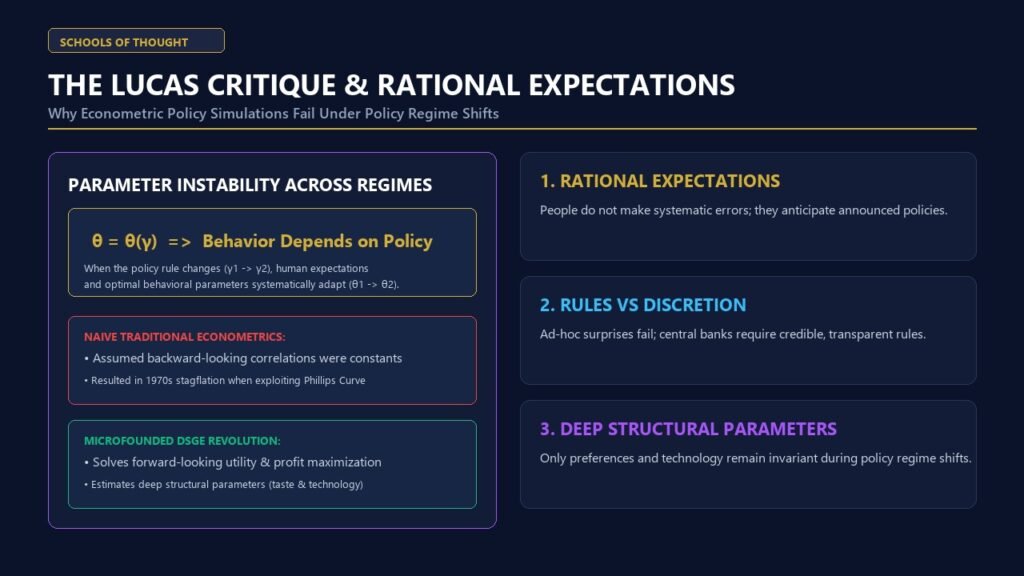
Executive Definition: The Lucas critique explained simply is the fundamental methodological insight in macroeconomics stating that it is naive to predict the effects of a change in economic policy using relationships observed in historical econometric data. Formulated by Nobel laureate Robert E. Lucas Jr. in 1976, the critique demonstrates that because rational individuals and forward-looking firms systematically adapt their expectations and behaviors when government policy rules change, the statistical parameters of historical macroeconomic models alter, rendering retrospective forecasting models completely invalid.
Prior to the 1970s, economic policymaking was dominated by large-scale empirical systems—often comprising hundreds of simultaneous regression equations—that treated macroeconomic relationships as fixed mechanical plumbing. When policymakers attempted to exploit these historical correlations to permanently reduce unemployment, the result was catastrophic stagflation: double-digit inflation accompanied by surging joblessness. Today, having the Lucas critique explained from its mathematical foundations to modern dynamic stochastic general equilibrium (DSGE) modeling is indispensable for central bankers, empirical researchers, and economic students navigating quantitative policy design.
Table of Contents
- 1. The Pre-Lucas Paradigm: Large-Scale Macroeconometrics and the Cowles Commission
- 2. The Formal Mathematical Formulation of the Critique
- 3. The Empirical Disaster: The Collapse of the Exploitability of the Phillips Curve
- 4. The Engine of the Critique: The Rational Expectations Hypothesis
- 5. The Microfoundations Revolution: Recovering Deep Structural Parameters
- 6. Policy Implications: Rules vs. Discretion and Central Bank Credibility
- 7. Worked Illustrative Example: Income Tax Cuts and Forward-Looking Labor Supply
- 8. Modern DSGE Modeling: How Macroeconomists Answered Lucas
- 9. Comparative Matrix: Traditional Keynesian Econometrics vs. Post-Lucas DSGE
- 10. Frequently Asked Questions (FAQ)
- 11. Authoritative References & Primary Sources
1. The Pre-Lucas Paradigm: Large-Scale Macroeconometrics and the Cowles Commission
In the decades following World War II, macroeconomics was characterized by an ambitious engineering mindset. Pioneered by Jan Tinbergen, Lawrence Klein, and the Cowles Commission, economists constructed massive econometric forecasting models (such as the MPS model developed by the Federal Reserve, MIT, and Penn). These models estimated statistical coefficients from past aggregate time series data, assuming that parameters governing consumption propensities, investment elasticities, and money demand were invariant constants of nature.
Policymakers treated these econometric equations like the instrument panel of an airplane: if the historical data showed that a 1% increase in the money supply lowered unemployment by 0.5% with only a 0.2% increase in inflation, fiscal and monetary authorities believed they could dial the levers of spending and money growth to perpetually fine-tune macroeconomic performance.
In his landmark 1976 paper, “Econometric Policy Evaluation: A Critique”, published in the Carnegie-Rochester Conference Series on Public Policy, Robert Lucas delivered an intellectual shockwave that shattered this consensus, arguing that treating decision rules as constant under shifting policy regimes violated the basic tenets of economic theory.
2. The Formal Mathematical Formulation of the Critique
Lucas framed his critique using explicit state-space mathematical notation. Consider an economy where an economic outcome vector $y_t$ (such as aggregate output or inflation) is determined by an econometric relationship:
y_{t+1} = F(y_t, x_t, \epsilon_t; \theta)
Where:
- $y_t$ is the state vector of endogenous economic variables.
- $x_t$ is the vector of exogenous policy instruments (tax rates, government spending, target interest rates) chosen by the government according to a policy rule: $x_t = G(y_t; \gamma)$, where $\gamma$ represents the current policy regime.
- $\epsilon_t$ is a vector of stochastic random shocks.
- $\theta$ is the vector of estimated empirical behavioral parameters (e.g., historical marginal propensity to consume or money demand elasticity).
The traditional econometric approach assumed that the parameter vector $\theta$ was policy-invariant—meaning that if policymakers altered the policy regime from $\gamma_1$ to $\gamma_2$, they could plug the new policy series $x_t$ into the historical function $F(\cdot; \theta)$ to forecast future economic trajectories $y_{t+1}$.
Lucas demonstrated that because aggregate macroeconomic outcomes are the aggregated choices of forward-looking agents who solve dynamic optimization problems (maximizing lifetime utility or discounted corporate profits), their optimal decision rules depend directly on the perceived policy environment:
\theta = \theta(\gamma)
Because the structural behavioral parameters $\theta$ are themselves a mathematical function of the prevailing policy rule $\gamma$, any change in government policy ($\gamma_1 \to \gamma_2$) systematically alters the behavioral parameters of the economy ($\theta(\gamma_1) \to \theta(\gamma_2)$). Consequently, an econometric model estimated under policy regime $\gamma_1$ will give completely erroneous predictions when evaluated under policy regime $\gamma_2$.
3. The Empirical Disaster: The Collapse of the Exploitability of the Phillips Curve
The most famous empirical casualty of the Lucas Critique was the traditional, static Phillips Curve. In 1958, A.W. Phillips identified a stable historical negative correlation between nominal wage growth and unemployment in the United Kingdom over a century of data. Paul Samuelson and Robert Solow adapted this into a policy menu in 1960: governments could choose lower unemployment if they were willing to tolerate moderate inflation.
Throughout the 1960s, the Federal Reserve attempted to exploit this trade-off by running loose monetary policy to maintain full employment. However, as Milton Friedman (1968), Edmund Phelps (1968), and Robert Lucas (1972) demonstrated, workers and businesses are not passive automatons suffering from permanent money illusion:
- Under the historical gold standard regime, inflation had been mean-reverting and temporary; workers therefore did not adjust inflation expectations when price spikes occurred.
- Once policymakers switched to an aggressive, sustained inflationary policy regime, rational economic agents adapted their forecasting models. Workers realized that wage gains were being eroded by price hikes and began demanding higher cost-of-living adjustments in advance.
- The historical statistical relationship vanished. By the mid-1970s, the United States suffered from simultaneous double-digit inflation and high unemployment (stagflation). The short-run Phillips curve shifted upward, exactly as the Lucas Critique predicted.
For a detailed breakdown of how modern central banks model these tradeoffs, explore our analysis of the Phillips Curve tradeoff and see how general equilibrium operates in our explainer on the IS-LM model.
4. The Engine of the Critique: The Rational Expectations Hypothesis
At the philosophical and mathematical center of the Lucas Critique is the Rational Expectations Hypothesis (REH), originally formulated by John Muth in 1961 and applied to macroeconomics by Lucas, Thomas Sargent, and Neil Wallace. Rational expectations does not assume that human beings are omniscient or possess crystal balls; rather, it assumes that:
- Economic agents do not make systematic, predictable forecasting errors over time.
- Individuals use all available historical and forward-looking information—including announced government fiscal plans, central bank policy reaction functions, and economic theory—to form expectations.
- Subjective mathematical probability distributions held by private economic agents coincide with the true objective probability distribution generated by the underlying economic system: $\mathbb{E}_t [y_{t+1} | \Omega_t] = \mathbb{E}[y_{t+1} | \Omega_t]$, where $\Omega_t$ is the information set available at time $t$.
Under rational expectations, backward-looking “adaptive expectations” (where people assume tomorrow’s inflation will simply be a moving average of the past three years) is irrational. If a government announces a doubling of the national debt to finance consumer subsidies, citizens immediately anticipate future tax increases and inflationary pressure, altering their savings and consumption habits today.
5. The Microfoundations Revolution: Recovering Deep Structural Parameters
Lucas did not merely destroy pre-existing macroeconometric methods; he provided the constructive solution that redefined how academic macroeconomics is conducted. Lucas argued that if reduced-form statistical correlations are unstable under policy shifts, economists must build models based exclusively on deep structural parameters that are genuinely policy-invariant.
These deep structural parameters reside at the microeconomic foundation of human choice:
- Household Preferences: Intertemporal elasticity of substitution, risk aversion coefficients, and the subjective rate of time preference (impatience).
- Production Technology: Capital share of output ($\alpha$ in a Cobb-Douglas production function), rate of capital depreciation ($\delta$), and total factor productivity.
- Physical & Institutional Constraints: Resource endowments, budget constraints, and structural market frictions (such as Calvo staggered price contracts).
Because deep psychological preferences and physical production technologies do not change merely because the central bank raises the benchmark policy interest rate, models founded on these micro-foundations remain robust and invariant across policy regime changes.
6. Policy Implications: Rules vs. Discretion and Central Bank Credibility
The Lucas Critique, expanded by Finn Kydland and Edward Prescott in their 1977 Nobel Prize-winning work on time inconsistency, revolutionized central banking and fiscal policy design:
- The Death of Discretionary “Surprise” Policy: When policymakers attempt to use discretionary surprises to stimulate employment, rational agents anticipate the cheat and raise wage demands, resulting in higher inflation with zero employment dividend.
- The Primacy of Rules and Credibility: Policymakers achieve optimal economic outcomes by binding themselves to credible, systematic, transparent rules rather than acting ad hoc. This insight directly birthed modern institutional central banking designs: independent monetary authorities, explicit numeric inflation targets (e.g., 2% target anchors), and forward guidance communication frameworks.
7. Worked Illustrative Example: Income Tax Cuts and Forward-Looking Labor Supply
To demonstrate the operational failure of backward-looking econometrics, consider a government contemplating a 10% temporary reduction in labor income tax rates to stimulate labor supply and consumer spending.
The Naive Econometric Prediction:
The government runs an ordinary least squares (OLS) regression on historical data during an era when tax rates fluctuated around a permanent baseline, estimating a historical labor supply elasticity of $\eta = 0.40$. The policy model calculates that a 10% tax reduction will expand aggregate labor hours by $0.40 \times 10\% = 4.0\%$, increasing GDP and producing a projected surge in consumer spending.
The Lucas Critique Reality (Forward-Looking Agents):
Under rational expectations, households recognize that the tax cut is temporary and unfunded. Households understand the sovereign intertemporal budget constraint: lower taxes today without a reduction in government expenditures implies higher taxes tomorrow (the Ricardian Equivalence insight). Instead of spending the tax windfall, households save the additional income to pay for future tax liabilities. Furthermore, workers may engage in intertemporal labor substitution—working harder during the low-tax window but abruptly collapsing hours once the tax holiday expires. The actual macroeconomic response deviates dramatically from the historical econometric projection because agents altered their decision rules.
8. Modern DSGE Modeling: How Macroeconomists Answered Lucas
Modern macroeconomics answered the Lucas Critique by inventing Dynamic Stochastic General Equilibrium (DSGE) models. These models unify microeconomic foundations with macroeconomic fluctuations:
- Dynamic: Capturing intertemporal optimization across multiple time horizons, where expectations of future interest rates and taxes dictate current decisions.
- Stochastic: Incorporating random technology, fiscal, preference, and monetary policy shocks.
- General Equilibrium: Ensuring that all markets (labor, goods, bonds, and capital) clear simultaneously subject to behavioral micro-foundations.
Major institutions—including the Federal Reserve (FRB/US and SIGMA models), the European Central Bank (NAWM), and the International Monetary Fund (GIMF)—rely on modern DSGE architectures specifically constructed to resist the pitfalls identified by Lucas.
9. Comparative Matrix: Traditional Keynesian Econometrics vs. Post-Lucas DSGE
| Analytical Dimension | Pre-1970s Traditional Macroeconometrics | Post-Lucas Modern DSGE Framework |
|---|---|---|
| Core Behavioral Assumption | Historical regression correlations are stable constants | Agents optimize dynamically; behavior changes with policy |
| Expectations Formulation | Adaptive or static expectations (backward-looking) | Rational expectations (forward-looking & model-consistent) |
| Theoretical Foundations | Reduced-form aggregate accounting identities | Microfoundations: utility and profit maximization |
| Vulnerability to Regime Shifts | Extremely high; collapses during institutional changes | Resistant; parameters tied to tastes and technologies |
| Policy Recommendations | Discretionary fine-tuning and active aggregate intervention | Credible institutional rules, transparency, and anchored expectations |
10. Frequently Asked Questions (FAQ)
What is the core argument of the Lucas Critique?
The Lucas Critique argues that historical economic data cannot be used to predict the consequences of a new economic policy because people and businesses rationally adjust their behavior, expectations, and strategies whenever government policy rules change, invalidating the historical parameters of the model.
How did the Lucas Critique explain the stagflation of the 1970s?
During the 1970s, policymakers tried to exploit the historical Phillips Curve to maintain low unemployment by generating inflation. However, workers recognized that inflation was destroying their purchasing power and rationally demanded higher wages in advance, destroying the historical correlation and triggering simultaneous high inflation and high unemployment.
What are “deep parameters” in the context of the Lucas Critique?
“Deep parameters” are fundamental microeconomic characteristics of an economy that do not change when government policies shift. These include household preferences (such as risk aversion and patience), technology parameters (capital production elasticity), and physical resource constraints.
Did the Lucas Critique render all econometrics useless?
No. The critique demonstrated that econometrics cannot be used for naive policy simulations where structural behavior is treated as constant. It gave birth to structural econometrics, vector autoregressions (VARs), and calibrated DSGE modeling designed specifically to account for regime shifts.
Why is the Lucas Critique important for central bank credibility?
The critique showed that if a central bank acts unpredictably or changes policy discretionarily, private agents will anticipate inflation and price it in. To achieve price stability without triggering deep recessions, central banks must establish credible, transparent, rules-based monetary frameworks that securely anchor public expectations.
11. Authoritative References & Primary Sources
- Lucas, Robert E., Jr. (1976). “Econometric Policy Evaluation: A Critique.” Carnegie-Rochester Conference Series on Public Policy, 1, 19–46.
- Muth, John F. (1961). “Rational Expectations and the Theory of Price Movements.” Econometrica, 29(3), 315–335.
- Sargent, Thomas J., & Wallace, Neil. (1975). “‘Rational’ Expectations, the Optimal Monetary Instrument, and the Optimal Money Supply Rule.” Journal of Political Economy, 83(2), 241–254.
- Kydland, Finn E., & Prescott, Edward C. (1977). “Rules Rather than Discretion: The Inconsistency of Optimal Plans.” Journal of Political Economy, 85(3), 473–492.
- Woodford, Michael. (2003). Interest and Prices: Foundations of a Theory of Monetary Policy. Princeton University Press.