Executive Definition: The middle-income trap explained describes an empirical economic condition where rapidly developing nations attain middle-income status by shifting agricultural labor into low-cost export manufacturing, but subsequently stagnate and fail to transition into advanced, high-income knowledge economies. Originally coined by World Bank economists Indermit Gill and Homi Kharas in 2007, this structural plateau occurs when rising domestic wage levels eliminate a country’s labor cost advantage before domestic firms cultivate the innovation capacity and institutional sophistication required to compete with advanced global economies.
Over the past seven decades, dozens of emerging economies successfully escaped extreme poverty and reached middle-income status. However, according to historical World Bank data, out of 101 middle-income economies in 1960, only 13 managed to successfully cross the high-income threshold by 2008. Having the middle-income trap explained through neoclassical growth modeling, the Lewis Turning Point, and Solow growth dynamics illustrates why the policy playbooks that drive early industrialization become completely obsolete once labor surpluses evaporate. In this in-depth guide, we analyze the structural bottlenecks that paralyze developing nations, derive the mathematical limits of capital accumulation, and evaluate the institutional reforms proven to breach this development ceiling.
Table of Contents
- 1. Theoretical Foundations: The Lewis Model and the Cost-Productivity Squeeze
- 2. The Solow Productivity Wall: Why Capital Deepening Reaches Diminishing Returns
- 3. Econometric Evidence: Growth Slowdown Thresholds at $10,000–$16,000 Per Capita
- 4. Premature Deindustrialization: The Modern Emerging Market Pitfall
- 5. Historical Case Studies: East Asian Escapees vs. Latin American Stagnation
- 6. The Policy Matrix: Four Pillars for Escaping the Trap
- 7. Comparative Framework: Low-Income vs. Middle-Income vs. High-Income Growth Dynamics
- 8. Frequently Asked Questions (FAQ)
- 9. Authoritative References & Empirical Sources
1. Theoretical Foundations: The Lewis Model and the Cost-Productivity Squeeze
To grasp why economic growth slows down dramatically once a nation reaches approximately $10,000 to $15,000 in per capita GDP, economists rely on Sir Arthur Lewis’s Dual-Sector Model. In the initial development phase, an economy possesses a vast pool of surplus agricultural labor operating at near-zero marginal productivity. By simply shifting these workers into urban export factories, the economy enjoys explosive, non-inflationary growth. Capitalists earn massive profits and reinvest them into more factories, keeping wages suppressed due to endless labor supply.
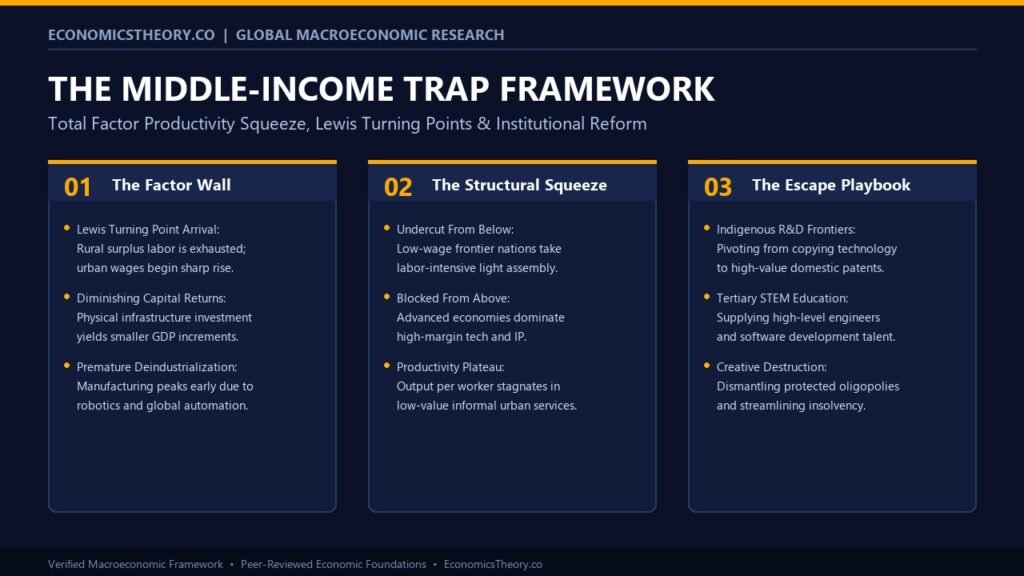
Eventually, the economy reaches the Lewis Turning Point: surplus rural labor is fully absorbed into modern industrial sectors. At this juncture, factory owners must bid up wages to attract scarce workers. Suddenly, the country’s foundational growth engine—cheap, abundant labor—vanishes. The country finds itself caught in an acute structural squeeze:
- From Below: Low-income nations with lower wage floors (such as Vietnam, Bangladesh, or East African economies) undercut its traditional labor-intensive exports (apparel, basic assembly).
- From Above: Advanced high-income economies (such as Germany, Japan, or South Korea) dominate high-margin, knowledge-intensive industries via intellectual property, automation, and complex supply networks that the middle-income nation cannot yet match.
2. The Solow Productivity Wall: Why Capital Deepening Reaches Diminishing Returns
In standard neoclassical growth accounting based on the Cobb-Douglas production function, output ($Y$) is determined by physical capital ($K$), labor ($L$), and Total Factor Productivity ($A$):
$$Y = A K^\alpha L^{1-\alpha}$$
Where $\alpha$ represents the output elasticity of capital, typically estimated at 0.3 to 0.4. Early middle-income growth is overwhelmingly factor-intensive: pouring concrete, erecting bridges, importing foreign capital equipment, and mobilizing labor. In this phase, capital deepening ($\Delta K$) yields rapid expansions in output per worker.
However, the law of diminishing marginal returns dictates that each additional unit of capital yields progressively smaller increments of GDP ($\frac{\partial Y}{\partial K} = \alpha A K^{\alpha-1} L^{1-\alpha}$). Building a nation’s first major deep-water port yields transformative economic gains; building an eighth parallel port produces marginal returns while saddling local governments with unserviceable debt. To maintain sustained growth above 5% per annum, the growth model must pivot decisively from input accumulation to efficiency gains (Total Factor Productivity, $\Delta A$). If domestic institutions, university systems, and corporate research ecosystems fail to cultivate indigenous technological innovation, TFP growth flatlines, locking the economy into stagnation.
3. Econometric Evidence: Growth Slowdown Thresholds at $10,000–$16,000 Per Capita
In an influential empirical study published by the National Bureau of Economic Research (NBER), economists Barry Eichengreen, Donghyun Park, and Kwanho Shin (2013) analyzed historical growth slowdowns across emerging markets over a 50-year horizon. Their econometric findings identified two distinct statistical modal peaks where economic growth decelerates precipitously:
- The First Slowdown Peak: Occurs when per capita GDP reaches approximately $10,000 to $11,000 (measured in 2005 purchasing power parity dollars). At this level, low-hanging fruit in basic manufacturing is exhausted.
- The Second Slowdown Peak: Occurs around $15,000 to $16,000 per capita GDP. Here, nations that failed to develop competitive domestic financial markets, intellectual property protection, and high-tech export clusters experience sharp growth deceleration, often dropping from 6–8% annualized growth to under 2.5%.
Crucially, the authors found that growth slowdowns are overwhelmingly driven by collapses in Total Factor Productivity growth rather than capital or labor slowdowns, accounting for approximately 85% of the total drop in economic output.
4. Premature Deindustrialization: The Modern Emerging Market Pitfall
As documented extensively by Harvard economist Dani Rodrik, modern middle-income economies face a distinct hurdle that 19th-century Britain or 20th-century Japan never encountered: premature deindustrialization. Due to global automation, advanced robotics, and highly consolidated global value chains, manufacturing has become vastly more capital-intensive and less capable of absorbing mass low-skilled labor.
Consequently, many middle-income nations in Latin America, South Asia, and Sub-Saharan Africa see the manufacturing share of their GDP and employment peak at much lower income thresholds than advanced economies did historically. Workers transition directly from agriculture into low-productivity, informal urban services (retail, food delivery, domestic care) rather than high-productivity manufacturing. Informal service sectors lack economies of scale, technological spillover effects, and export tradability, severely dampening long-term wage growth.
5. Historical Case Studies: East Asian Escapees vs. Latin American Stagnation
The historical divergence between South Korea and Latin American economies like Brazil or Argentina provides the ultimate empirical laboratory for studying the middle-income trap:
- The South Korean Miracle (Successful Escape): In the 1960s, South Korea was an impoverished agrarian society with per capita income lower than several African nations. The state implemented discipline-based industrial policy (via chaebols), aggressively tied state subsidies to rigorous export benchmarks, invested heavily in tertiary STEM education, and poured massive GDP shares into R&D (exceeding 4.5% of GDP today). By pivoting from textiles in the 1970s to heavy industry in the 1980s, and high-tech semiconductors and consumer electronics in the 1990s, South Korea breached the high-income threshold.
- The Latin American Plateau (The Entrenched Trap): Conversely, nations like Brazil, Mexico, and Argentina attained middle-income status decades ago but became mired in structural stagnation. Contributing factors included inward-looking Import Substitution Industrialization (ISI), chronic macroeconomic instability, low domestic savings rates, elite capture of state institutions, and insufficient investment in workforce skills and patent creation.
6. The Policy Matrix: Four Pillars for Escaping the Trap
Escaping the middle-income trap requires a fundamental overhaul of national economic strategy. Development economists highlight four indispensable policy pillars:
- 1. Human Capital & Advanced Tertiary Education: Transitioning from universal primary education to top-tier technical and university schooling to supply skilled engineers, software architects, and managerial talent.
- 2. Creative Destruction & Competition Law: Dismantling state-protected monopolies and politically connected oligarchies. Facilitating the entry of innovative startups while allowing uncompetitive zombie firms to exit through streamlined bankruptcy codes.
- 3. Financial Deepening & Equity Financing: Developing mature venture capital, private equity, and corporate bond markets so that growth relies on risk-tolerant equity capital rather than state bank collateral lending.
- 4. Institutional Quality & Rule of Law: Enforcing intellectual property rights, transparent judicial enforcement, and predictable regulatory environments that encourage multi-decade corporate capital expenditure.
7. Comparative Framework: Low-Income vs. Middle-Income vs. High-Income Growth Dynamics
| Growth Dimension | Low-to-Middle Income Phase | Middle-to-High Income Transition |
|---|---|---|
| Primary Growth Driver | Factor accumulation (Capital & Labor mobilization) | Total Factor Productivity (Innovation & TFP) |
| Competitive Advantage | Low labor costs & abundant natural resources | Patents, brand equity, advanced engineering |
| Technological Role | Technology adoption & foreign machinery copying | Domestic invention & indigenous R&D frontiers |
| Key Bottleneck | Basic infrastructure (power, roads, basic literacy) | Institutional rent-seeking, brain drain, poor R&D |
| Financial Architecture | State-directed bank loans & FDI subsidies | Venture capital, deep liquid corporate bond markets |
8. Frequently Asked Questions (FAQ)
Q1: What is the exact income threshold for the middle-income trap?
According to the World Bank classification, middle-income economies are those with Gross National Income (GNI) per capita between approximately $1,146 and $14,005. Countries caught in the trap typically stagnate in the upper-middle bracket ($4,500 to $12,000) for several decades without converging toward developed nation benchmarks.
Q2: Why didn’t East Asian tigers get stuck in the middle-income trap?
Economies like South Korea, Taiwan, and Singapore avoided the trap by pairing aggressive export discipline with heavy state investments in human capital, technical universities, and private-sector R&D incentives, allowing domestic firms (e.g., Samsung, TSMC) to lead global technology frontiers.
Q3: Is India currently at risk of falling into the middle-income trap?
India is currently transitioning through lower-middle-income status. While its digital public infrastructure, demographic dividend, and service exports are strong, avoiding future traps will require rapidly boosting high-value manufacturing, reforming agricultural markets, improving learning outcomes in basic schooling, and increasing female workforce participation.
Q4: How does institutional corruption contribute to the trap?
Corruption and regulatory capture protect inefficient incumbent firms from market competition. When profits depend on political connections rather than innovative patents, capital is misallocated to unproductive rent-seeking activities rather than productivity-enhancing technological R&D.
9. Authoritative References & Empirical Sources
- World Bank Group: Gill, I., & Kharas, H. (2007). “An East Asian Renaissance: Ideas for Economic Growth”, World Bank Publications.
- National Bureau of Economic Research (NBER): Eichengreen, B., Park, D., & Shin, K. (2013). “Growth Slowdowns Redux: New Evidence on the Middle-Income Trap”, NBER Working Paper No. 18673.
- Harvard Kennedy School: Rodrik, D. (2016). “Premature Deindustrialization”, Journal of Economic Growth, 21(1), 1-33.
- Asian Development Bank (ADB): Felipe, J., Abdon, A., & Kumar, U. (2012). “Tracking the Middle-Income Trap: What Is It, Who Is in It, and Why?” ADB Economics Working Paper Series No. 306.