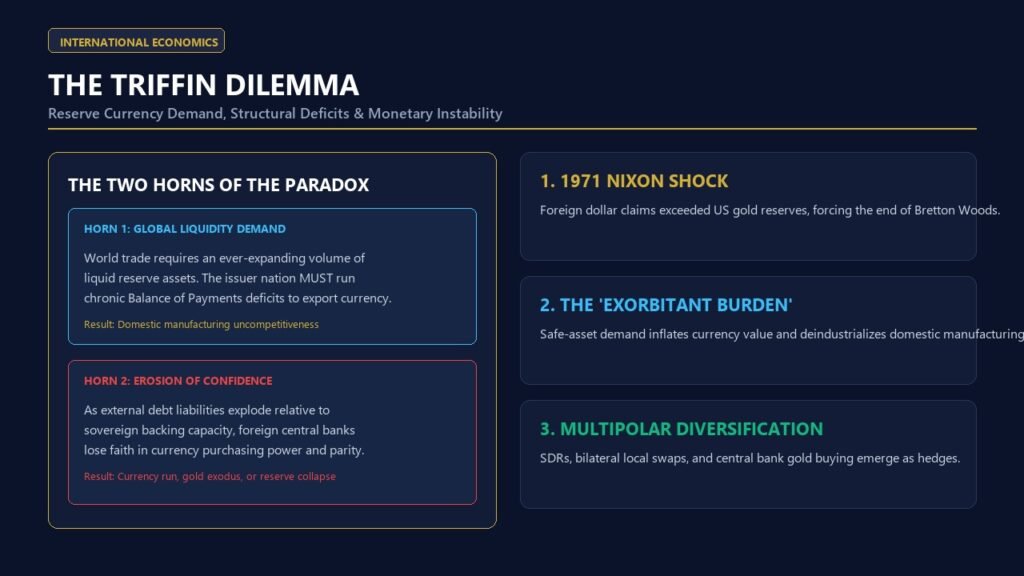
Executive Definition: Triffin dilemma explained simply describes the structural conflict of interest that arises when a single national fiat currency serves simultaneously as the world’s primary global reserve currency. To satisfy international demand for trade settlement and central bank reserves, the issuer nation must supply ample liquidity by running continuous current account deficits. However, prolonged deficits inevitably flood the globe with foreign-held obligations, eroding international confidence in the anchor currency’s purchasing power and ultimately precipitating systemic monetary crises.
Formulated by Belgian-American economist Robert Triffin in his seminal 1960 book Gold and the Dollar Crisis: The Future of Convertibility, this paradox exposed a fatal architectural defect at the heart of the post-WWII Bretton Woods monetary system. While the world demands an expanding stock of risk-free liquid assets to grease international commerce, satisfying that appetite forces the reserve provider into irreversible macroeconomic imbalances. Today, having the Triffin dilemma explained from foundational balance-of-payments accounting to modern de-dollarization dynamics is vital for understanding why global financial architecture periodically fractures and why multilateral institutions continually search for alternative reserve assets.
Table of Contents
- 1. Historical Genesis: Robert Triffin and the Bretton Woods Flaw
- 2. The Two Horns of the Dilemma: Liquidity vs. Confidence
- 3. Balance-of-Payments Accounting: The Mechanics of Deficit Export
- 4. The 1971 Nixon Shock: How Triffin’s Prediction Came True
- 5. The Modern Fiat Triffin Dilemma: Safe Asset Shortages and Deindustrialization
- 6. “Exorbitant Privilege” vs. “Exorbitant Burden”
- 7. Multipolar Alternatives: SDRs, Bilateral Swaps, and Gold Renaissance
- 8. Comparative Matrix: Global Reserve Architectures Through History
- 9. Frequently Asked Questions (FAQ)
- 10. Authoritative References & Primary Sources
1. Historical Genesis: Robert Triffin and the Bretton Woods Flaw
In July 1944, delegates from 44 Allied nations convened at Bretton Woods, New Hampshire, to establish a stable post-war international economic order. The resulting architecture pegged the US dollar to physical gold at a fixed parity of $35 per troy ounce, while other member currencies pegged their exchange rates to the dollar within narrow 1% fluctuation bands. Central banks could convert their dollar reserves into gold at the US Treasury’s “gold window” at will.
By 1960, Yale professor Robert Triffin identified an inescapable mathematical contradiction in this design during his testimony before the Joint Economic Committee of the US Congress. As world trade expanded exponentially during post-war European and Japanese reconstruction, the global volume of commerce required a commensurate expansion in international reserves. Because global gold production grew at an sluggish rate of only 1% to 1.5% annually, the world relied entirely on the United States to supply liquidity by spending, investing, and lending more dollars abroad than it took in—effectively running persistent Balance of Payments deficits.
Triffin warned that if the United States stopped running deficits, international liquidity would dry up, causing worldwide economic deflation and trade contraction (the “liquidity horn”). Conversely, if the US continued running deficits to lubricate global commerce, foreign-held dollar liabilities would inevitably outstrip the physical gold reserves held at Fort Knox, sparking a run on the US gold window and shattering international confidence in the dollar (the “confidence horn”).
2. The Two Horns of the Dilemma: Liquidity vs. Confidence
The structural elegance of the Triffin Dilemma lies in its demonstration that both available policy paths lead to systemic destabilization. The reserve-issuing nation is caught between two irreconcilable imperatives:
- Horn 1: The Liquidity Starvation Trap (Under-Supply of Reserves): If the anchor nation balances its current account or runs a surplus, it stops net dollar outflows to the rest of the world. Because trading nations need reserve assets to settle cross-border transactions and build defensive foreign exchange buffers, a curtailment of dollar outflows creates a global liquidity famine. As observed in the 1930s under the classical gold standard, a shortage of international reserves triggers competitive currency devaluations, tariff wars, and widespread deflationary depressions.
- Horn 2: The Confidence Collapse Trap (Over-Supply of Reserves): To prevent global illiquidity, the anchor nation runs ongoing deficits, exporting its currency through capital investments, foreign aid, and trade imbalances. Over time, external liabilities accumulate exponentially while the domestic backing assets (whether physical gold reserves under Bretton Woods or fiscal capacity and sovereign credibility in a fiat regime) grow at a much slower rate. Foreign central banks inevitably realize that the anchor nation cannot honor its obligations under stress, triggering capital flight, currency dumping, and hyperinflationary risk.
3. Balance-of-Payments Accounting: The Mechanics of Deficit Export
To grasp the technical plumbing of the dilemma, one must analyze the fundamental Balance of Payments (BoP) identity. Across any sovereign economy, the national accounting identity states:
Current Account (CA) + Capital & Financial Account (FA) = 0
Where the Current Account represents net exports of goods, services, and net investment income, and the Financial Account reflects net international purchases of financial assets (sovereign bonds, equities, bank deposits, and direct investment). Rearranging the macroeconomic savings-investment identity yields:
CA = (S – I) + (T – G)
Here, $(S – I)$ represents private sector net savings (private savings minus domestic capital investment) and $(T – G)$ represents the public sector budget balance (tax revenues minus government expenditures). For the rest of the world to accumulate foreign exchange reserves in the anchor currency, the rest of the world must run a combined Financial Account deficit with the reserve issuer—meaning they must acquire claims on the issuer’s economy ($FA_{foreign} < 0$).
By double-entry identity, the reserve issuer must absorb this global inflow by running a corresponding Financial Account surplus ($FA_{issuer} > 0$), which mechanically forces its Current Account into deficit ($CA_{issuer} < 0$). Consequently, the reserve issuer must either depress domestic private savings ($S < I$) or run persistent fiscal deficits ($G > T$). The global demand for dollar reserves literally forces the domestic United States economy into fiscal or private sector indebtedness.
4. The 1971 Nixon Shock: How Triffin’s Prediction Came True
Throughout the 1960s, Triffin’s thesis played out with textbook precision. As the US financed both the Vietnam War and Lyndon B. Johnson’s Great Society programs alongside heavy private foreign direct investment in Europe, global dollar liabilities surged. By 1970, foreign central banks held over $40 billion in official liquid dollar claims, while total US gold reserves had depleted from $25 billion in 1945 to under $10 billion.
European monetary authorities—most visibly the Banque de France under Charles de Gaulle—recognized the unhedged exposure and began repatriating their gold reserves by exchanging dollars for bullion at the Federal Reserve. When West Germany and the United Kingdom indicated similar intentions in mid-1971, the system reached its mathematical breaking point.
On August 15, 1971, President Richard Nixon announced the unilateral suspension of the dollar’s convertibility into gold, effectively ending the Bretton Woods system. The “Nixon Shock” severed the final institutional link between national currencies and physical precious metals, ushering in our current era of pure floating fiat exchange rates. Triffin had predicted the exact mechanism and timing of this collapse more than a decade before it occurred.
5. The Modern Fiat Triffin Dilemma: Safe Asset Shortages and Deindustrialization
The collapse of gold convertibility in 1971 did not extinguish the Triffin Dilemma; rather, it mutated into a modern fiat incarnation. In the contemporary international monetary system, the US dollar remains the dominant reserve asset, constituting roughly 58% of global allocated foreign exchange reserves, over 85% of foreign exchange transactions, and more than 50% of global trade invoicing.
In this post-Bretton Woods environment, global demand for reserves is driven not by gold convertibility, but by the search for ultra-liquid, deep, default-free “safe assets”—namely, US Treasury securities. This dynamic creates two acute structural distortions:
- Persistent Current Account Deficits & Deindustrialization: Because foreign central banks and sovereign wealth funds systematically accumulate US Treasuries to protect against capital flight (a practice accelerated following the 1997 Asian Financial Crisis), they continuously bid up the value of the US dollar. An overvalued reserve currency makes domestic manufactured exports uncompetitive abroad while making foreign imports artificially cheap. Over decades, this dynamic has driven chronic trade deficits and hollowed out the industrial base in the Rust Belt.
- The Global “Savings Glut” and Asset Bubbles: As former Federal Reserve Chairman Ben Bernanke highlighted, surplus export economies (such as China, Germany, and the Gulf states) funnel their excess savings back into US capital markets. This deluge of foreign capital suppresses domestic interest rates below equilibrium, driving financial asset bubbles, encouraging reckless private subprime debt expansion, and complicating monetary policy transmission.
Readers exploring how central banks navigate conflicting external and domestic goals should review our comprehensive guide on the Impossible Trinity (Mundell-Fleming Trilemma) and examine how global flows interact with the mechanisms of the current account deficit.
6. “Exorbitant Privilege” vs. “Exorbitant Burden”
Economists frequently debate whether the Triffin Dilemma confers an unfair macroeconomic advantage or imposes an unsustainable structural tax on the reserve currency provider:
- The Exorbitant Privilege (Valéry Giscard d’Estaing): Coined in the 1960s by the French finance minister, this perspective emphasizes that the US can issue debt in its own fiat currency at low borrowing costs, purchase real physical goods and services from the rest of the world by simply printing digital ledger credits, and never face a traditional sovereign solvency crisis. Additionally, the US earns higher returns on its foreign equity and direct investments than it pays to foreign investors holding low-yielding Treasury bills (the “venture capitalist of the world” phenomenon).
- The Exorbitant Burden (Matthew Klein & Michael Pettis): Conversely, modern trade economists emphasize that the reserve issuer loses control over its domestic unemployment and manufacturing competitiveness. The reserve issuer becomes the consumer of last resort for mercantilist nations pursuing export-led growth through currency undervaluation. Domestic fiscal authorities are forced to run large budget deficits to prevent aggregate demand from collapsing under the weight of trade leakage.
7. Multipolar Alternatives: SDRs, Bilateral Swaps, and Gold Renaissance
The geopolitical frictions inherent in the Triffin Dilemma—amplified in recent years by the weaponization of the dollar via SWIFT sanctions and sovereign asset freezes—have accelerated the international search for viable monetary alternatives:
- Special Drawing Rights (SDRs): Created by the International Monetary Fund (IMF) in 1969 specifically to address Triffin’s critique, the SDR is a synthetic supranational reserve basket comprising the US Dollar, Euro, Chinese Renminbi, Japanese Yen, and British Pound Sterling. While John Maynard Keynes originally proposed a similar supranational currency named the “Bancor” at Bretton Woods, the SDR currently lacks broad commercial liquidity and private market debt issuance.
- Bilateral Currency Swap Lines & Local Currency Clearing: Non-aligned and emerging market nations are increasingly bypassing the dollar altogether. Cross-border bilateral settlements in Chinese Renminbi (CIPS), Indian Rupees, and UAE Dirhams have expanded rapidly across energy trade corridors, reducing transactional reliance on Western financial clearinghouses.
- Official Central Bank Gold Accumulation: Faced with counterparty risk on fiat sovereign debt, central banks worldwide have purchased physical gold bullion at historic paces (surpassing 1,000 metric tons annually). Gold represents a neutral, unencumbered reserve asset with no single sovereign liability attached, directly mitigating Triffin exposure.
8. Comparative Matrix: Global Reserve Architectures Through History
| Reserve Architecture | Anchor Asset | Liquidity Source | Primary Triffin Vulnerability | Historical Outcome |
|---|---|---|---|---|
| Classical Gold Standard (1870–1914) | Physical Gold Bullion | Mining production & trade surpluses | Inflexible liquidity supply; structural deflation | Suspended during World War I mobilization |
| Bretton Woods System (1944–1971) | US Dollar ($35/oz Gold convertibility) | US Balance of Payments deficits | Foreign dollar liabilities exceeded Fort Knox gold | Collapsed in 1971 (Nixon Shock) |
| Petrodollar / Fiat Standard (1973–Present) | US Treasury Securities & Fed Reserves | US current account deficits & capital inflows | US deindustrialization, debt saturation, dollar weaponization | Active fragmentation into a multipolar reserve regime |
| Keynesian Supranational Model (Bancor / SDR) | Synthetic Multilateral Currency Basket | IMF / Multilateral quota allocations | Lack of sovereign taxing authority & private liquid debt markets | Limited to institutional balance-sheet support |
9. Frequently Asked Questions (FAQ)
What is the core conflict explained by the Triffin Dilemma?
The core conflict is that the nation issuing the global reserve currency must run continuous trade and current account deficits to supply global commerce with necessary liquidity. However, running these persistent deficits inevitably degrades foreign confidence in the long-term value and stability of the currency, ultimately destabilizing the entire international monetary system.
Did the Triffin Dilemma end when the US abandoned the gold standard in 1971?
No. While leaving the gold standard resolved the direct risk of a physical run on Fort Knox gold reserves, the dilemma morphed into a fiat version. Today, the world’s hunger for US Treasuries as “safe assets” forces the US to run perpetual trade deficits, leading to domestic manufacturing decline and unprecedented public debt burdens.
Why can’t another national currency like the Euro or Chinese Yuan simply replace the dollar?
To replace the dollar, an economy must provide massive, transparent, deep, and liquid capital markets with zero capital controls, alongside an independent legal judiciary that protects foreign assets. Furthermore, the issuing country must be willing to sacrifice its domestic manufacturing sector by running massive current account deficits—a condition neither export-dependent Germany (Eurozone) nor China has been willing to accept.
How does the Triffin Dilemma relate to John Maynard Keynes’s “Bancor” proposal?
During the 1944 Bretton Woods conference, John Maynard Keynes anticipated this dilemma and proposed an international clearing union with an independent supranational unit of account called the “Bancor.” Under Keynes’s system, both surplus and deficit countries would face penalties to maintain equilibrium. The US rejected the Bancor in favor of the US dollar, directly seeding the vulnerabilities that Robert Triffin later documented.
What is the relationship between the Triffin Dilemma and de-dollarization?
De-dollarization is the practical manifestation of foreign central banks seeking to diversify away from Triffin risks and political sanctions. By settling trade in local currencies and converting excess reserves into physical gold or alternative bilateral assets, nations seek to insulate their economies from US fiscal expansion and weaponized currency controls.
10. Authoritative References & Primary Sources
- Triffin, Robert. (1960). Gold and the Dollar Crisis: The Future of Convertibility. Yale University Press.
- Bernanke, Ben S. (2005). “The Global Saving Glut and the U.S. Current Account Deficit.” Federal Reserve Board Speech.
- Gourinchas, Pierre-Olivier, & Rey, Hélène. (2007). “From World Banker to World Venture Capitalist: US External Adjustment and the Exorbitant Privilege.” NBER Working Paper No. 11563.
- International Monetary Fund (IMF). (2023). “The International Role of the US Dollar and Currency Reserve Diversification.” IMF Economic Review.
- Bank for International Settlements (BIS). (2022). “Triennial Central Bank Survey of Foreign Exchange and Over-the-Counter Derivatives Markets.” BIS Official Data.