Introduction: The Economics of Inflation
Inflation is the sustained increase in the general price level of goods and services in an economy over time. Consequently, it represents a decline in the purchasing power of money. While moderate inflation is a target for most modern central banks, volatile or hyper-inflation can severely distort economic decision-making.
Measuring Inflation: CPI and PCE
Inflation is measured by tracking the cost of a “basket” of goods over time. The formula for the inflation rate between two periods is:
$$ \pi_t = \frac{Price Index_t – Price Index_{t-1}}{Price Index_{t-1}} \times 100 $$
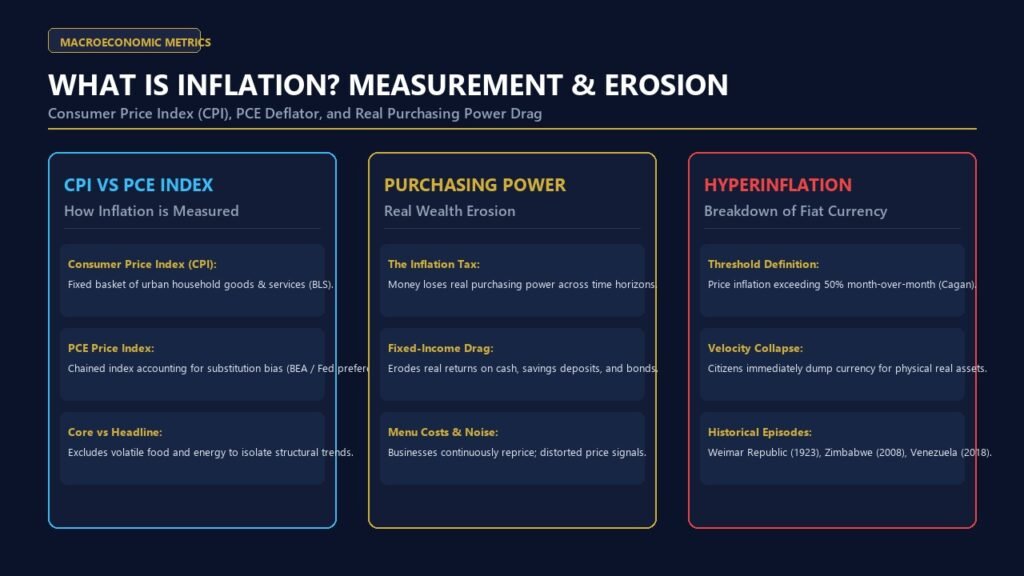
- Consumer Price Index (CPI): Measures out-of-pocket spending by urban consumers. It uses a fixed basket of goods updated periodically.
- Personal Consumption Expenditures (PCE): The US Federal Reserve’s preferred metric. It adjusts dynamically for consumer substitution (e.g., if beef gets expensive, consumers buy chicken) and includes indirect expenditures like employer-provided healthcare.
Worked Numerical Example: The Fisher Equation
Inflation fundamentally alters the return on investments, described by the Fisher Equation:
$$ 1 + i = (1 + r)(1 + \pi^e) \implies r \approx i – \pi^e $$
Where: i = nominal interest rate; r = real interest rate; $\pi^e$ = expected inflation rate.
If a bank offers a nominal savings rate of 5% ($i = 0.05$) but inflation is 7% ($\pi = 0.07$), the real interest rate is: $r = 5\% – 7\% = -2\%$. The saver is losing 2% of their purchasing power annually despite earning nominal interest. This demonstrates how inflation acts as a hidden tax on savings.
Historical Case Study: Weimar Germany Hyperinflation
Following WWI, the Weimar Republic faced massive war reparations. Unable to pay, the government abandoned fiscal discipline and printed fiat currency (Papiermark) to pay striking workers. By late 1923, prices were doubling every few days. The monetary dynamics of hyperinflation (studied by Phillip Cagan) show that as inflation expectations approach infinity, money velocity spikes because citizens dump currency immediately for real goods, exacerbating the price spiral until the currency collapses.
Frequently Asked Questions
What is “Core Inflation”?
Core inflation excludes highly volatile items, specifically food and energy. Central banks focus on core inflation because it better reflects underlying macroeconomic trends rather than temporary supply shocks in oil or agriculture.
Why do central banks target 2% inflation instead of 0%?
A small, positive inflation target prevents the economy from slipping into deflation, which can cause debt spirals. It also provides a “cushion” for nominal interest rates to be cut during recessions without hitting the zero lower bound.