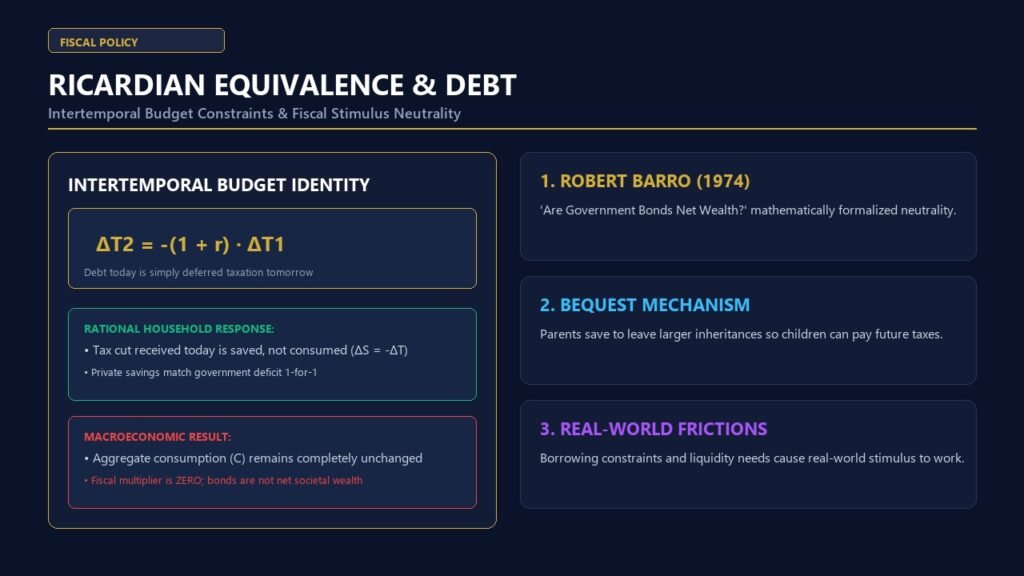
Executive Definition: Ricardian equivalence explained simply is an economic proposition asserting that government deficit spending financed by debt issuance has no net impact on aggregate demand, national savings, or economic growth. First hypothesized by classical economist David Ricardo and mathematically modernized by Harvard economist Robert Barro in 1974, the theory posits that forward-looking, rational households understand that current tax cuts financed by government borrowing must be repaid through higher taxes in the future, prompting them to save the entire tax rebate rather than spending it.
In standard Keynesian macroeconomic models, when a government cuts taxes during an economic downturn, consumers treat the extra disposable cash as a windfall, boosting consumer spending, stimulating business revenues, and generating a positive fiscal multiplier. However, having Ricardian equivalence explained through modern dynamic macroeconomics challenges this orthodox view by arguing that government debt is not perceived as net wealth by society. If taxpayers anticipate the future tax bills required to service sovereign bonds, fiscal stimulus loses its potency, rendering the choice between taxation and debt financing macroeconomically neutral.
Table of Contents
- 1. Intellectual Roots: David Ricardo’s Skepticism and Robert Barro’s 1974 Revival
- 2. The Intertemporal Government Budget Constraint: Mathematical Proof
- 3. The Rational Consumer’s Lifetime Optimization Problem
- 4. The Bequest Mechanism: Why Mortality Does Not Break Equivalence
- 5. Step-by-Step Worked Two-Period Numerical Example
- 6. Why Ricardian Equivalence Breaks Down in the Real World
- 7. Fiscal Policy Implications: Crowding Out vs. Deficit Neutrality
- 8. Comparative Matrix: Keynesian Stimulus vs. Ricardian Neutrality vs. MMT
- 9. Frequently Asked Questions (FAQ)
- 10. Authoritative References & Primary Sources
1. Intellectual Roots: David Ricardo’s Skepticism and Robert Barro’s 1974 Revival
The concept originated in David Ricardo’s 1820 essay, “Funding System.” Ricardo posed a thought experiment: suppose the British government needs to raise £20 million to finance a war. It can either levy an immediate lump-sum tax of £20 million across the population, or it can issue government bonds paying interest of £1 million every year in perpetuity (assuming a 5% interest rate), funded by a perpetual annual tax of £1 million.
Ricardo reasoned that to a fully rational individual, both financing methods are mathematically identical: paying £20 million today reduces present net wealth by exactly £20 million, while paying £1 million every year forever has a discounted present value of exactly £20 million. Interestingly, Ricardo himself was skeptical that actual citizens would calculate present values so rigorously, observing that people suffer from fiscal illusion and treat debt-financed spending as “free money.”
In 1974, Harvard economist Robert Barro formalized the proposition within modern neoclassical general equilibrium theory in his seminal paper, “Are Government Bonds Net Wealth?” published in the Journal of Political Economy. Barro demonstrated that under rational expectations and operative intergenerational bequest motives, government debt does not constitute net societal wealth, sparking one of the most intense debates in modern macroeconomics.
2. The Intertemporal Government Budget Constraint: Mathematical Proof
To understand the formal mechanics, consider a two-period macroeconomic model (Period 1 = Present, Period 2 = Future). The sovereign government chooses spending levels ($G_1, G_2$) and tax collections ($T_1, T_2$), financing any first-period deficit by issuing bonds ($B_1$) at real interest rate $r$:
G_1 = T_1 + B_1 \implies B_1 = G_1 – T_1
In Period 2, the government must service and fully pay off the outstanding bond principal plus accrued interest, subject to terminal solvency (no Ponzi games):
G_2 + (1 + r)B_1 = T_2
Substituting the Period 1 borrowing equation ($B_1 = G_1 – T_1$) into the Period 2 budget constraint yields:
G_2 + (1 + r)(G_1 – T_1) = T_2
Dividing by $(1 + r)$ and rearranging produces the intertemporal government budget constraint:
G_1 + \frac{G_2}{1 + r} = T_1 + \frac{T_2}{1 + r}
This identity demonstrates that the present discounted value of all government purchases must equal the present discounted value of all tax revenues. For a given path of government expenditures ($G_1, G_2$), any reduction in current taxes ($\Delta T_1 < 0$) mathematically necessitates an offsetting discounted increase in future taxes:
\Delta T_2 = -(1 + r)\Delta T_1
3. The Rational Consumer’s Lifetime Optimization Problem
Now consider the representative household that earns income ($Y_1, Y_2$) and chooses consumption ($C_1, C_2$) to maximize lifetime utility. The consumer’s intertemporal budget constraint is:
C_1 + \frac{C_2}{1 + r} = (Y_1 – T_1) + \frac{Y_2 – T_2}{1 + r}
Rearranging the right-hand side using the government’s intertemporal constraint:
C_1 + \frac{C_2}{1 + r} = Y_1 + \frac{Y_2}{1 + r} – \left(G_1 + \frac{G_2}{1 + r}\right)
The Fundamental Insight: Taxes ($T_1, T_2$) have completely vanished from the household’s budget constraint! What limits the private sector’s lifetime consumption is not the timing of taxes, but the total volume of resources absorbed by the state ($G_1, G_2$).
When the government cuts taxes today ($\Delta T_1 = -\$1,000$) by issuing bonds, rational consumers do not consume more. They know that in Period 2, they will face a tax bill of $\$1,000 \times (1 + r)$. Therefore, they place the entire $\$1,000$ rebate into savings (often buying the newly issued government bonds). Private savings increase dollar-for-dollar with the government deficit ($\Delta S_{private} = -\Delta S_{public}$), leaving aggregate consumption ($C_1$), interest rates ($r$), and national savings completely unchanged.
4. The Bequest Mechanism: Why Mortality Does Not Break Equivalence
A frequent initial objection to Ricardian equivalence is human mortality: “Why should I care if future taxes rise thirty years from now when I will already be dead?”
Barro solved this through the intergenerational altruism model. Parents do not merely consume during their own lifetimes; they care about the utility of their children and grandchildren, linked through financial bequests. When the government issues debt that postpones taxation to the next generation, parents recognize that their children will face higher taxes.
To prevent their children’s living standards from deteriorating, parents increase the size of their financial bequests by the exact value of the tax cut. The family dynasty acts as if it possesses an infinite planning horizon, preserving Ricardian neutrality across generations.
5. Step-by-Step Worked Two-Period Numerical Example
Consider an economy where a representative citizen lives for two periods:
- Income in both periods: $Y_1 = \$50,000, Y_2 = \$50,000$.
- Real interest rate: $r = 10\%$ ($0.10$).
- Government purchases: $G_1 = \$10,000, G_2 = \$11,000$.
Baseline Scenario: Balanced Budget
The government balances budgets each period: $T_1 = \$10,000$ and $T_2 = \$11,000$. Disposable income is $Y_1 – T_1 = \$40,000$ and $Y_2 – T_2 = \$39,000$. Lifetime wealth is:
Wealth = 40,000 + \frac{39,000}{1.10} = 40,000 + 35,455 = \$75,455
Assuming the consumer prefers perfectly smooth consumption ($C_1 = C_2$):
C_1 + \frac{C_1}{1.10} = 75,455 \implies 1.909 C_1 = 75,455 \implies C_1 = \$39,524
\text{Private Savings } S_1 = 40,000 – 39,524 = \$476
Stimulus Scenario: A $5,000 Debt-Financed Tax Cut
The government cuts Period 1 taxes by $\$5,000$ ($T_1′ = \$5,000$), issuing $\$5,000$ in bonds. In Period 2, the government must repay the debt with interest: $T_2′ = \$11,000 + \$5,000(1.10) = \$16,500$.
Recalculate the consumer’s lifetime wealth:
Wealth’ = (50,000 – 5,000) + \frac{50,000 – 16,500}{1.10} = 45,000 + \frac{33,500}{1.10} = 45,000 + 30,455 = \$75,455
Lifetime wealth is identical ($75,455). Optimal consumption remains unchanged at $C_1 = \$39,524$. New private savings become:
S_1′ = (Y_1 – T_1′) – C_1 = 45,000 – 39,524 = \$5,476
Private savings increased by exactly $\$5,000$ (from $\$476$ to $\$5,476$). Consumption spending did not increase by a single cent; the Keynesian fiscal multiplier is exactly zero.
6. Why Ricardian Equivalence Breaks Down in the Real World
Empirical evidence demonstrates that while Ricardian equivalence is theoretically rigorous, it rarely holds in pure form due to friction-filled real-world constraints:
- Liquidity & Borrowing Constraints: A significant portion of households live paycheck-to-paycheck and cannot borrow against future earnings. When given a tax rebate, these credit-constrained consumers spend it immediately on overdue bills and groceries (their marginal propensity to consume is close to 1).
- Myopic & Non-Rational Expectations: Real-world consumers do not solve complex intertemporal Euler equations. Many suffer from fiscal illusion, believing that tax cuts reflect permanent wealth increases.
- Distortionary vs. Lump-Sum Taxes: In the real world, governments levy distortionary income, capital gains, and sales taxes rather than lump-sum taxes. Shifting tax timing alters labor supply and investment incentives, violating neutrality.
- Childless Households & Incomplete Altruism: Individuals without heirs have no incentive to leave bequests to offset future sovereign debt, leading them to consume the tax rebate during their lifetime.
To analyze how governments manage sovereign debt trajectories under real-world interest-growth dynamics, read our comprehensive guide on the Debt-to-GDP ratio and the r – g rule and examine how fiscal spending impacts aggregate demand in our analysis of the fiscal multiplier.
7. Fiscal Policy Implications: Crowding Out vs. Deficit Neutrality
The Ricardian equivalence debate carries massive practical consequences for economic policy:
- If Ricardian Equivalence Holds: Tax cuts are completely ineffective for stimulating an economy out of a recession. Furthermore, government deficits do not crowd out private investment or drive up real interest rates because private savings expand dollar-for-dollar with public debt issuance.
- If Ricardian Equivalence Fails: Deficit-financed tax cuts provide potent short-term aggregate demand stimulus, but run the risk of crowding out private capital accumulation and inflating sovereign debt burdens over the long term.
8. Comparative Matrix: Keynesian Stimulus vs. Ricardian Neutrality vs. MMT
| Macroeconomic Dimension | Keynesian Fiscal Framework | Ricardian Equivalence (Barro) | Modern Monetary Theory (MMT) |
|---|---|---|---|
| Consumer Behavior | Myopic; high marginal propensity to consume ($0 < MPC < 1$) | Forward-looking; rational lifetime utility optimization | Credit-led; spending determined by employment and income |
| Impact of Tax Cuts | Substantial GDP boost via the Keynesian multiplier | Zero consumption change; 100% saved for future taxes | Increases private sector financial net wealth |
| Perception of Bonds | Bonds are viewed as net wealth by households | Bonds are matched dollar-for-dollar by future tax liabilities | Sovereign bonds are liquid asset reserves for banks |
| Crowding-Out Risk | Deficits raise interest rates and crowd out private CapEx | Zero crowding out; private saving rises to fund deficits | Zero crowding out; central bank manages benchmark rate |
9. Frequently Asked Questions (FAQ)
What is Ricardian equivalence in simple terms?
Ricardian equivalence is the idea that whether a government funds its spending through immediate taxes or through debt borrowing makes no difference to the economy, because citizens realize that debt today simply means higher taxes tomorrow and save accordingly.
Why does Ricardian equivalence suggest tax cuts do not stimulate the economy?
Because rational, forward-looking taxpayers understand that a debt-financed tax cut is not free money. Anticipating the future taxes required to pay off the debt, households save the tax cut rather than spending it, leading to zero increase in consumer demand.
Did David Ricardo actually believe in Ricardian equivalence?
No, not entirely. While Ricardo proved the mathematical logic of the proposition in 1820, he explicitly stated that in practice, citizens suffer from “fiscal illusion” and fail to realize that public debt represents future tax liabilities.
What is the bequest mechanism in Robert Barro’s formulation?
The bequest mechanism explains that even if taxes are delayed until after current taxpayers die, parents will save the tax cut to leave larger inheritances (bequests) to their children, enabling their offspring to pay the future tax bill without lowering their living standards.
Why do stimulus checks increase spending in the real world despite Ricardian equivalence?
In the real world, many lower- and middle-income families face borrowing constraints and have urgent immediate needs. When they receive stimulus checks, they spend the money on necessary goods rather than saving it, causing Ricardian equivalence to break down empirically.
10. Authoritative References & Primary Sources
- Ricardo, David. (1820). “Funding System.” In P. Sraffa (Ed.), The Works and Correspondence of David Ricardo, Vol. IV. Cambridge University Press.
- Barro, Robert J. (1974). “Are Government Bonds Net Wealth?” Journal of Political Economy, 82(6), 1095–1117.
- Buchanan, James M. (1976). “Barro on Ricardian Equivalence.” Journal of Political Economy, 84(2), 337–342.
- Feldstein, Martin. (1982). “Government Deficits and Aggregate Demand.” Journal of Monetary Economics, 9(1), 1–20.
- Mankiw, N. Gregory. (2000). “The Savers-Spenders Theory of Fiscal Policy.” American Economic Review, 90(2), 120–125.