Executive Definition: Post-Keynesian Economics is an intellectual school of macroeconomic thought built upon the foundational insights of John Maynard Keynes, Michal Kalecki, and Joan Robinson. Rejecting the neoclassical synthesis, Post-Keynesian theory establishes that modern capitalist economies operate in historical, irreversible time under fundamental Knightian uncertainty. At its analytical vanguard stands Stock-Flow Consistent (SFC) modeling, pioneered by British economist Wynne Godley: by enforcing strict double-entry balance sheet accounting across all economic sectors—where every monetary flow comes from somewhere and ends up somewhere—SFC models map endogenous money creation, private debt accumulation, and systemic financial fragility.
1. Core Philosophical Foundations: Historical Time and Fundamental Uncertainty
While New Keynesian economics attempted to reconcile Keynesian sticky wages with neoclassical general equilibrium theory, Post-Keynesian Economics argues that this synthesis eviscerated Keynes’s most radical insights. At the heart of the Post-Keynesian paradigm lie three core ontological axioms:
1. Fundamental (Knightian) Uncertainty vs. Ergodic Risk
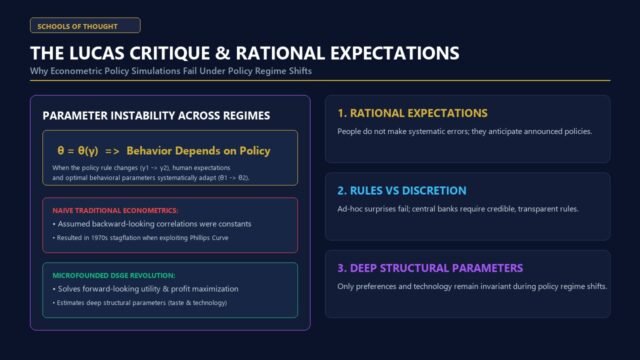
Mainstream Dynamic Stochastic General Equilibrium (DSGE) models assume that economic agents operate under measurable probabilistic risk: economic actors know the underlying probability distribution of future outcomes and form “rational expectations.” Post-Keynesians follow Frank Knight and John Maynard Keynes in asserting that the economic future is fundamentally uncertain and unknowable:
“By ‘uncertain’ knowledge, I do not mean merely to distinguish what is known for certain from what is only probable… There is no scientific basis on which to form any calculable probability whatever. We simply do not know.” — John Maynard Keynes (1937)
Because the future cannot be calculated mathematically, economic actors rely on social conventions, heuristics, and volatile “animal spirits.” When confidence shatters, agents hoard liquid money as a safe haven, causing aggregate investment to collapse and plunging the economy into underemployment equilibrium.
2. Historical Time vs. Logical Equilibrium Time
Neoclassical models operate in “logical time,” where economies instantaneously jump between steady-state equilibria. Post-Keynesians insist on historical time: the economic process is irreversible. Decisions made in the past (such as building a factory or signing a debt contract) cannot be undone today, and decisions made today permanently alter future economic trajectories (path dependency and hysteresis).
3. The Principle of Effective Demand
Post-Keynesians assert that aggregate output and employment are determined by effective demand across both the short run and the long run. There is no automatic supply-side anchor that pulls an economy back to full employment; capitalist economies can remain trapped in deep underutilization indefinitely unless fiscal policy intervenes.
2. The Cambridge Capital Controversy and the Rejection of Neoclassical Frontiers
During the 1950s and 1960s, the fierce intellectual clash between Cambridge, England (Joan Robinson, Piero Sraffa) and Cambridge, Massachusetts (Paul Samuelson, Robert Solow)—known as the Cambridge Capital Controversy—shook the foundations of economic theory.
The English Post-Keynesians proved that the neoclassical aggregate production function ($Y = A \cdot K^\alpha \cdot L^{1-\alpha}$) is logically incoherent. In neoclassical theory, physical “capital” ($K$) is treated as a single quantifiable physical magnitude whose marginal product determines the real rate of profit. However, Joan Robinson pointed out that physical capital consists of heterogeneous goods (bulldozers, conveyor belts, software) that cannot be summed together in physical units. To sum them into a single aggregate $K$, they must be valued in monetary prices:
However, to calculate the prices ($p_i$) of capital goods, one must already know the prevailing rate of profit and interest rate! Neoclassical theory committed circular reasoning: it used the quantity of capital to determine the profit rate, while needing the profit rate to determine the quantity of capital. Sraffa proved the phenomena of reswitching and capital reversing, demonstrating that lower interest rates do not mechanically induce firms to adopt more “capital-intensive” production methods. Paul Samuelson conceded the theoretical debate in 1966, establishing the Post-Keynesian critique as mathematically irrefutable.
3. Endogenous Money and the Circuitist Theory of Banking
Decades before central banks officially admitted that commercial banks create money, Post-Keynesian economists—led by Nicholas Kaldor, Basil Moore, and Hyman Minsky—formulated the Theory of Endogenous Money. Rejecting the neoclassical money multiplier theory, Post-Keynesians demonstrated that money is an endogenous debt creation:
In the French-Italian Monetary Circuit Theory (Augusto Graziani), the economic process unfolds in three consecutive steps:
- Initial Financing: Commercial banks grant credit to entrepreneurial firms to finance wage payrolls and capital equipment, creating purchasing power out of nothing.
- Production and Circulation: Workers spend wage income on consumer goods produced by firms.
- Final Flux and Debt Destruction: Firms use sales revenue to repay bank loans, extinguishing the broad money supply.
To examine the balance-sheet accounting of commercial banking in detail, read our comprehensive guide on How Commercial Banks Create Money and explore financial instability in Credit Cycles and the Minsky Moment.
4. Wynne Godley and the Sectoral Balances Identity
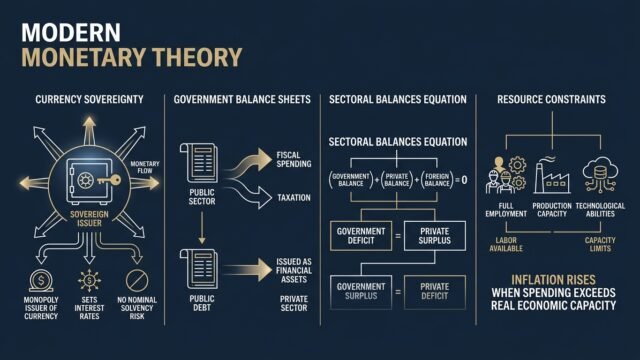
In the 1990s, British Post-Keynesian economist Wynne Godley developed the Sectoral Balances Framework, establishing that macroeconomics is governed by unbreakable double-entry national accounting identities. Dividing the aggregate national economy into three discrete institutional sectors:
- The Private Domestic Sector ($S – I$): Private household and business savings minus private capital investment.
- The Public Government Sector ($T – G$): Government tax revenues minus government spending (the fiscal budget balance).
- The External Foreign Sector ($M – X$): Total imports minus exports (the current account deficit).
Because every dollar spent by one entity is earned by another entity, the sum of net financial balances across all three sectors must sum to exactly zero by mathematical identity:
Rearranging the identity reveals the fundamental macroeconomic constraint:
This accounting certainty carries profound implications: For the private domestic sector to accumulate net financial savings ($S > I$), the government must run a fiscal deficit ($G > T$), or the nation must run a current account trade surplus ($X > M$). If a country runs a persistent trade deficit while the government balances its budget, the private household sector is mathematically forced into net debt accumulation, laying the structural groundwork for credit panics.
5. Stock-Flow Consistent (SFC) Modeling Architecture: Balance Sheet Accounting
Formulated comprehensively in Wynne Godley and Marc Lavoie’s 2007 masterwork, Monetary Economics, Stock-Flow Consistent (SFC) modeling provides the formal mathematical engine of modern Post-Keynesian economics. SFC models resolve the fatal flaw of neoclassical models: mainstream DSGE models often omit private banking, money creation, and gross debt balances.
In an SFC model, the entire economy is represented through two interconnected matrices:
1. The Balance Sheet Matrix (Stocks)
Tracks all assets (equities, bonds, bank deposits, loans, physical capital) and liabilities held by households, non-financial firms, commercial banks, the central bank, and the government at each point in time. Every asset listed on one balance sheet is an exact liability on another balance sheet. Summing across all sectors for any financial instrument yields zero.
2. The Transaction Flow Matrix (Flows)
Tracks every transaction occurring over the accounting period (wages, consumption, tax payments, interest transfers, investment purchases). Every flow has a sender and a receiver; there are no “black holes” where money mysteriously appears or vanishes.
| Institutional Sector | Primary Physical / Financial Assets | Primary Liabilities | Net Financial Position |
|---|---|---|---|
| Households | Bank deposits, government bonds, corporate equities, real estate | Mortgage loans, consumer credit lines | Typically net financial creditors ($S > I$) |
| Non-Financial Firms | Physical capital stock, operating bank deposits | Bank loans, corporate bonds, issued equity shares | Net borrowers financing capital investment |
| Commercial Banks | Customer loan receivables, central bank reserves, sovereign bonds | Customer deposits, interbank wholesale borrowing | Zero net financial position (financial intermediaries / money creators) |
| Government / Central Bank | Tax collection capacity, foreign exchange reserves | Sovereign Treasury debt, physical currency, central bank reserves | Net financial debtor enabling private net savings ($G > T$) |
Because stocks generate flows (e.g., debt stocks generate interest flows) and flows accumulate into stocks (e.g., net savings accumulate into wealth stocks), SFC models capture the dynamic buildup of debt-to-income ratios that trigger debt-deflation spirals.
6. Comparative Matrix: Post-Keynesian vs. New Keynesian vs. Neoclassical Economics
The table below summarizes the fundamental divergence between Post-Keynesian economics and other dominant macroeconomic schools:
| Analytical Dimension | Post-Keynesian Economics | New Keynesian Economics | Neoclassical / New Classical |
|---|---|---|---|
| Theory of Money | Endogenous; private banks create broad money via loan origination | Exogenous policy rate; Taylor Rule reaction; money as transaction friction | Exogenous money multiplier ($M = m \cdot B$); money is a neutral veil |
| Expectations & Time | Fundamental Knightian uncertainty; animal spirits; historical irreversible time | Rational expectations; dynamic stochastic probability distributions | Perfect foresight / Rational expectations; continuous market clearing |
| Primary Source of Instability | Endogenous credit cycles and financial fragility (Minsky Paradox) | Exogenous aggregate demand and supply shocks combined with price stickiness | Exogenous technology and productivity shocks (Real Business Cycles) |
| Role of Fiscal Policy | Continuous, permanent steering of aggregate demand and sectoral balances | Temporary countercyclical stimulus used only when rates hit Zero Lower Bound | Ricardian Equivalence neutralizes deficits; balanced budgets prioritized |
7. Forecasting Systemic Crises: Why SFC Models Predicted 2008 While DSGE Models Failed
The predictive superiority of Post-Keynesian Stock-Flow Consistent modeling was decisively demonstrated during the 2000s. While mainstream central bank economists using DSGE models published forecasts predicting uninterrupted “Great Moderation” stability, Wynne Godley and his colleagues at the Levy Economics Institute published papers in 2000, 2004, and 2006 accurately forecasting the 2008 Global Financial Crisis.
Godley’s sectoral accounting models revealed an unsustainable mathematical trajectory: during the US housing boom, the US private sector was running an unprecedented deficit of -4.0% to -6.0% of GDP, financing consumption by borrowing against home equity. Godley warned that once home price appreciation halted, private debt service ratios would explode, compelling households to slash spending, which would trigger a massive recession and financial collapse.
Following the 2008 crisis, central banks worldwide—including the Bank of England and the Bank for International Settlements—began integrating stock-flow consistent accounting frameworks and macroprudential credit monitoring tools to track systemic balance-sheet vulnerabilities.
To explore the broader history of macroeconomic debates, read our comprehensive comparative analysis on New Classical vs New Keynesian Economics and examine alternative schools in Austrian Economics Explained.
8. Frequently Asked Questions
How does Post-Keynesian economics differ from New Keynesian economics?
New Keynesians adopt neoclassical microeconomic foundations (utility maximization, rational expectations, general equilibrium) while introducing market frictions like sticky prices. Post-Keynesians reject neoclassical microfoundations entirely, emphasizing fundamental uncertainty, endogenous bank money creation, and non-clearing historical time.
Why is double-entry balance sheet consistency so important in macroeconomics?
Because financial assets cannot exist without an identical liability elsewhere in the financial system. Enforcing stock-flow consistency ensures that models do not inadvertently generate “free lunch” purchasing power or ignore the accumulation of debt service burdens that eventually trigger solvency crises.
What was the primary outcome of the Cambridge Capital Controversy?
English Post-Keynesians proved that physical capital cannot be aggregated into a single index number independent of the rate of profit. This mathematically undermined the neoclassical production function and demonstrated that interest rates do not simply reflect the “marginal productivity of capital.”
How does Modern Monetary Theory (MMT) fit into Post-Keynesian economics?
MMT is an offshoot of the Post-Keynesian tradition. It builds directly upon Wynne Godley’s sectoral balances, Abba Lerner’s functional finance, and Georg Friedrich Knapp’s state theory of money (Chartalism) to analyze fiscal policy in sovereign currency-issuing nations.
9. Primary Sources & Academic References
- Godley, Wynne, & Lavoie, Marc. (2007). Monetary Economics: An Integrated Approach to Credit, Money, Income, Production and Wealth. London: Palgrave Macmillan.
- Robinson, Joan. (1953). “The Production Function and the Theory of Capital.” Review of Economic Studies, 21(2), 81–106.
- Sraffa, Piero. (1960). Production of Commodities by Means of Commodities: Prelude to a Critique of Economic Theory. Cambridge: Cambridge University Press.
- Kaldor, Nicholas. (1982). The Scourge of Monetarism. Oxford: Oxford University Press.
- Lavoie, Marc. (2014). Post-Keynesian Economics: New Foundations. Cheltenham: Edward Elgar Publishing.
- National Bureau of Economic Research. (2020). Macroeconomic Accounting and Balance Sheet Fragility. NBER Working Paper Series, No. 27554.