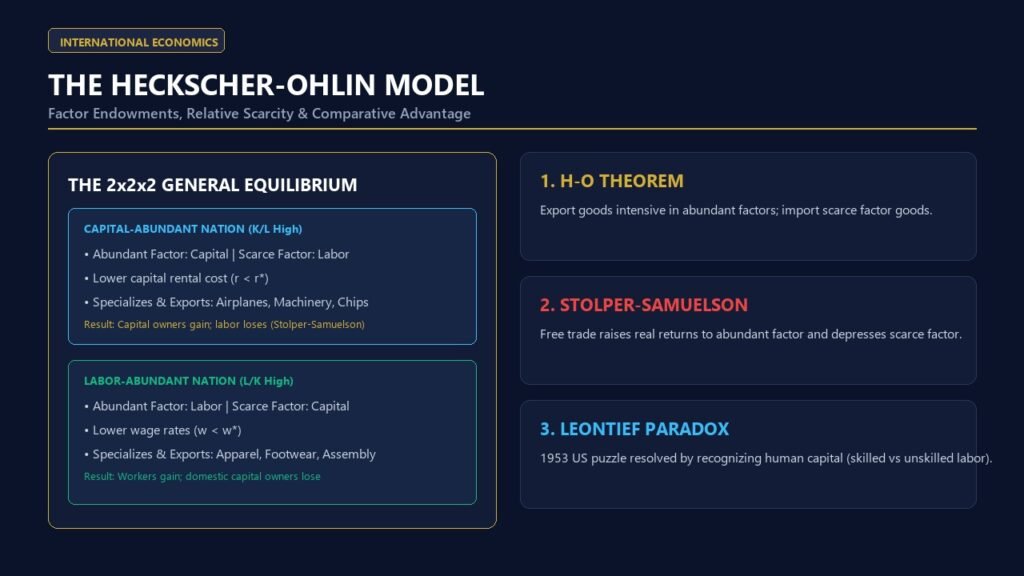
Executive Definition: The Heckscher Ohlin model explained simply is the foundational general equilibrium theory of international trade establishing that a nation’s comparative advantage is determined by its relative factor endowments. Developed by Swedish economists Eli Heckscher and Bertil Ohlin, the model proves that countries export commodities that intensively use their relatively abundant, inexpensive factors of production (such as capital or labor) and import commodities that intensively utilize their relatively scarce, expensive factors.
While David Ricardo’s classical 1817 trade theory demonstrated the power of comparative advantage, it relied on arbitrary differences in labor technology across borders without explaining where those productivity differentials originated. The Heckscher-Ohlin (H-O) framework revolutionized trade economics by demonstrating that comparative advantage is an endogenous outcome of national resource endowments: a nation blessed with vast capital will naturally produce aircraft and high-end microchips, while a nation with abundant labor will manufacture apparel and consumer electronics. Today, having the Heckscher Ohlin model explained through its four core theorems and real-world trade puzzles is essential for trade policy analysts, corporate supply chain planners, and macroeconomists.
Table of Contents
- 1. Historical Genesis: Beyond Ricardian Labor Theory to Factor Endowments
- 2. The Classical 2x2x2 Analytical Framework & Core Assumptions
- 3. The Four Pillar Theorems of the Heckscher-Ohlin Architecture
- 4. Theorem 1: The Heckscher-Ohlin Trade Pattern Theorem
- 5. Theorem 2: The Stolper-Samuelson Theorem & Domestic Income Distribution
- 6. Theorem 3: The Rybczynski Theorem & Factor Accumulation
- 7. Theorem 4: Factor Price Equalization (FPE)
- 8. The Leontief Paradox: The Great Empirical Earthquake of 1953
- 9. Modern Resolutions: Human Capital, Technology, and Global Value Chains
- 10. Comparative Matrix: Ricardo vs. Heckscher-Ohlin vs. New Trade Theory
- 11. Frequently Asked Questions (FAQ)
- 12. Authoritative References & Primary Sources
1. Historical Genesis: Beyond Ricardian Labor Theory to Factor Endowments
In 1817, David Ricardo demonstrated that nations gain from trade by specializing in goods where their opportunity costs are lowest (the famous England-cloth and Portugal-wine example). However, Ricardo’s model treated labor as the sole factor of production and assumed that international technology differences fell from the sky without explanation. Furthermore, the Ricardian framework implied that trade creates only winners, obscuring the bitter political fights that accompany trade liberalization.
In a 1919 treatise, Eli Heckscher of the Stockholm School of Economics argued that differing relative supplies of productive factors—land, labor, and capital—drive cost differentials across borders. His student, Bertil Ohlin, expanded and mathematically refined the concept in his 1933 landmark work, Interregional and International Trade (work for which Ohlin shared the 1977 Nobel Memorial Prize in Economic Sciences). Paul Samuelson subsequently formalized the model using general equilibrium mathematics in the 1940s and 1950s, creating the standard Heckscher-Ohlin-Samuelson (HOS) synthesis that anchors modern trade theory.
2. The Classical 2x2x2 Analytical Framework & Core Assumptions
The standard Heckscher-Ohlin model operates in a clean general equilibrium world defined by the “2x2x2” structure:
- Two Countries: Home ($H$) and Foreign ($F$).
- Two Factors of Production: Capital ($K$) and Labor ($L$). Both factors are in fixed total supply within each nation, fully employed, and completely mobile between domestic industries, but strictly immobile between nations.
- Two Commodities: Good 1 (e.g., Apparel) and Good 2 (e.g., Airplanes).
The model rests on several critical analytical assumptions:
- Identical Technologies: Both nations have access to the exact same production functions with constant returns to scale.
- Differing Factor Intensities: At any common factor price ratio ($w/r$), Good 2 is strictly capital-intensive and Good 1 is strictly labor-intensive ($K_2/L_2 > K_1/L_1$). There are no factor intensity reversals.
- Differing Factor Endowments: Home is relatively capital-abundant, meaning its total ratio of capital to labor exceeds Foreign’s: $(K/L)_H > (K/L)_F$. By complement, Foreign is relatively labor-abundant.
- Identical and Homothetic Consumer Preferences: Consumers in both countries share identical tastes across all income levels, ensuring trade patterns reflect supply-side cost differences rather than demand anomalies.
- Zero Trade Frictions: Perfect competition in all goods and factor markets, zero transport costs, and no tariffs or import quotas.
3. The Four Pillar Theorems of the Heckscher-Ohlin Architecture
The general equilibrium solution to the H-O system generates four foundational theorems that govern international commerce and domestic wealth distribution:
4. Theorem 1: The Heckscher-Ohlin Trade Pattern Theorem
Formal Proposition: A nation will export the commodity whose production requires the intensive use of the nation’s relatively abundant and cheap factor of production, and import the commodity whose production requires the intensive use of the nation’s relatively scarce and expensive factor.
The Economic Mechanism:
In autarky (self-sufficiency), capital is abundant in Home, driving the domestic rental rate of capital ($r$) down relative to wages ($w$). Consequently, capital-intensive airplanes (Good 2) are cheaper to produce in Home. Conversely, in Foreign, labor is abundant, making wages ($w^*$) low relative to capital rentals ($r^*$), rendering labor-intensive apparel (Good 1) cheaper in Foreign.
When trade opens, Home manufacturers specialize in airplanes, exporting them abroad, while Foreign manufacturers specialize in apparel. Trade patterns flow directly from relative factor scarcity.
5. Theorem 2: The Stolper-Samuelson Theorem & Domestic Income Distribution
Published in 1941 by Wolfgang Stolper and Paul Samuelson, this theorem provides the profound political economy insight into why trade creates fierce domestic class conflict:
\Delta \left(\frac{P_2}{P_1}\right) > 0 \implies \hat{r} > \hat{P}_2 > \hat{P}_1 > \hat{w}
Formal Proposition: An increase in the relative price of a commodity increases the real return to the factor used intensively in its production and decreases the real return to the other factor.
Real-World Implication:
When capital-abundant Home opens to free trade, the price of capital-intensive airplanes rises. Capital owners in Home enjoy an unambiguous increase in real purchasing power ($\hat{r} > \hat{P}$). However, domestic low-skilled factory workers find their wages falling not only in nominal terms, but in real terms against all consumer goods ($\hat{w} < \hat{P}$).
The Stolper-Samuelson theorem mathematically proves that free trade inevitably harms the owners of a nation’s scarce factor. This explains why labor unions in developed economies consistently lobby for tariffs on imports from labor-rich emerging markets.
6. Theorem 3: The Rybczynski Theorem & Factor Accumulation
Formulated by Polish-British economist Tadeusz Rybczynski in 1955, this theorem examines how demographic or investment shocks alter industrial production:
Formal Proposition: At constant commodity prices, an increase in the endowment of one factor of production will lead to a more than proportional expansion in the output of the sector that uses that factor intensively, while causing an absolute contraction in the output of the other sector.
If Home experiences an influx of capital through foreign direct investment ($\Delta K > 0$), the airplane industry expands rapidly ($\Delta Y_2 / Y_2 > \Delta K / K$). To absorb the new capital, airplane manufacturers must recruit additional workers, drawing labor away from apparel factories. Consequently, domestic apparel production experiences an absolute decline ($\Delta Y_1 < 0$). This theorem forms the intellectual backbone for explaining “Dutch Disease” in resource-booming nations.
7. Theorem 4: Factor Price Equalization (FPE)
Formulated by Paul Samuelson in 1948, this striking proposition establishes the limits of free merchandise trade:
Formal Proposition: Under identical production functions, constant returns to scale, and zero trade barriers, free trade in final commodities will bring about complete international equalization in the absolute real returns to identical factors of production, even in the complete absence of international migration or cross-border capital investment.
Trading physical goods acts as an indirect, virtual trade in productive factors. Exporting labor-intensive apparel from India to the US is mathematically equivalent to exporting Indian labor services to the US. In theory, free trade alone should eventually equalize wage rates across nations.
8. The Leontief Paradox: The Great Empirical Earthquake of 1953
In 1953, Harvard economist Wassily Leontief (creator of input-output analysis and 1973 Nobel laureate) conducted the first rigorous empirical test of the Heckscher-Ohlin model using 1947 US trade and production data. Because the United States in 1947 possessed the most capital-abundant economy in human history, the H-O theorem produced an unmistakable prediction: US exports must be capital-intensive, and US imports must be labor-intensive.
Leontief calculated the capital-labor ratios embodied in $1 million worth of US exports and import-competing products. The results shocked the economics profession:
| Metric | US Exports (1947) | US Import Replacements (1947) |
|---|---|---|
| Capital ($K$) Required | $2,550,780 | $3,091,339 |
| Labor ($L$) Required | 182 person-years | 170 person-years |
| Capital per Worker ($K/L$) | $14,010 / worker | $18,180 / worker |
American exports were roughly 30% more labor-intensive than American import-competing industries! The most capital-rich nation on earth was exporting labor and importing capital. This empirical contradiction became known as the Leontief Paradox.
9. Modern Resolutions: Human Capital, Technology, and Global Value Chains
Subsequent empirical research successfully resolved Leontief’s paradox by refining the definition of productive factors:
- Human Capital Heterogeneity: Leontief had measured labor purely by raw headcount. In reality, American workers in 1947 possessed vastly superior education, engineering training, and managerial skill (human capital). Once economists segregated labor into skilled labor ($H$) and unskilled labor ($L$), the paradox dissolved: the US was heavily exporting skilled-labor-intensive and R&D-intensive goods while importing unskilled-labor-intensive goods.
- Natural Resource Endowments: Many capital-intensive US imports (such as oil refining and mineral extraction) were necessitated by geological scarcity rather than financial capital abundance.
- Intra-Industry Trade (New Trade Theory): As Paul Krugman demonstrated in 1979, the majority of modern global trade occurs between similar capital-abundant nations trading differentiated varieties of the same good (e.g., Germany exporting BMWs to the US while importing Teslas from the US), driven by economies of scale rather than factor endowment differences.
To understand how cross-border trade balances affect national borrowing, review our comprehensive explainer on the Balance of Payments mechanics and examine how global reserve demands alter manufacturing competitiveness in our analysis of the Triffin Dilemma.
10. Comparative Matrix: Ricardo vs. Heckscher-Ohlin vs. New Trade Theory
| Trade Theory | Source of Comparative Advantage | Key Factors Considered | Income Distribution Outcome | Primary Trade Pattern Explained |
|---|---|---|---|---|
| Ricardian Classical Model (1817) | International differences in labor productivity / technology | Homogeneous labor only | Everyone gains; zero domestic class conflict | Inter-industry trade between completely dissimilar economies |
| Heckscher-Ohlin Model (1933) | Differences in national factor endowments ($K/L$ ratios) | Physical capital and labor | Abundant factor gains; scarce factor suffers real losses (Stolper-Samuelson) | Inter-industry trade between capital-rich and labor-rich nations |
| Krugman New Trade Theory (1979) | Monopolistic competition, internal economies of scale, consumer love of variety | Firms, varieties, and scale economies | Widespread consumer welfare gains from product variety | Intra-industry trade between similar advanced industrial economies |
11. Frequently Asked Questions (FAQ)
What is the main prediction of the Heckscher-Ohlin model?
The main prediction is that countries export products that utilize their abundant factors of production (e.g., labor-abundant countries export textiles) and import products that require their scarce factors of production (e.g., importing high-tech machinery).
Why does the Stolper-Samuelson theorem explain political opposition to free trade?
The Stolper-Samuelson theorem proves that free trade causes an absolute reduction in the real income of workers or owners of a country’s scarce factor. For example, in a capital-rich country, low-skilled labor suffers wage cuts due to import competition, creating rational incentives to oppose trade agreements.
What was the Leontief Paradox?
The Leontief Paradox was the 1953 empirical discovery that the United States—the most capital-abundant nation in the world—was exporting labor-intensive goods and importing capital-intensive goods, contradicting the basic Heckscher-Ohlin prediction.
How did economists resolve the Leontief Paradox?
Economists resolved the paradox by separating raw labor from human capital (education and specialized skill). American workers embodied immense amounts of human capital, meaning US exports were actually intensive in high-skill knowledge rather than raw manual labor.
Does Factor Price Equalization occur in the real world?
No. In reality, factor prices do not equalize perfectly because real-world trade involves transportation costs, tariffs, institutional barriers, and fundamental cross-country differences in technology and infrastructure.
12. Authoritative References & Primary Sources
- Heckscher, Eli. (1919). “The Effect of Foreign Trade on the Distribution of Income.” Ekonomisk Tidskrift, 21, 1–32.
- Ohlin, Bertil. (1933). Interregional and International Trade. Harvard University Press.
- Stolper, Wolfgang F., & Samuelson, Paul A. (1941). “Protection and Real Wages.” The Review of Economic Studies, 9(1), 58–73.
- Rybczynski, Tadeusz M. (1955). “Factor Endowment and Relative Commodity Prices.” Economica, 22(88), 336–341.
- Leontief, Wassily. (1953). “Domestic Production and Foreign Trade; The American Capital Position Re-Examined.” Proceedings of the American Philosophical Society, 97(4), 332–349.