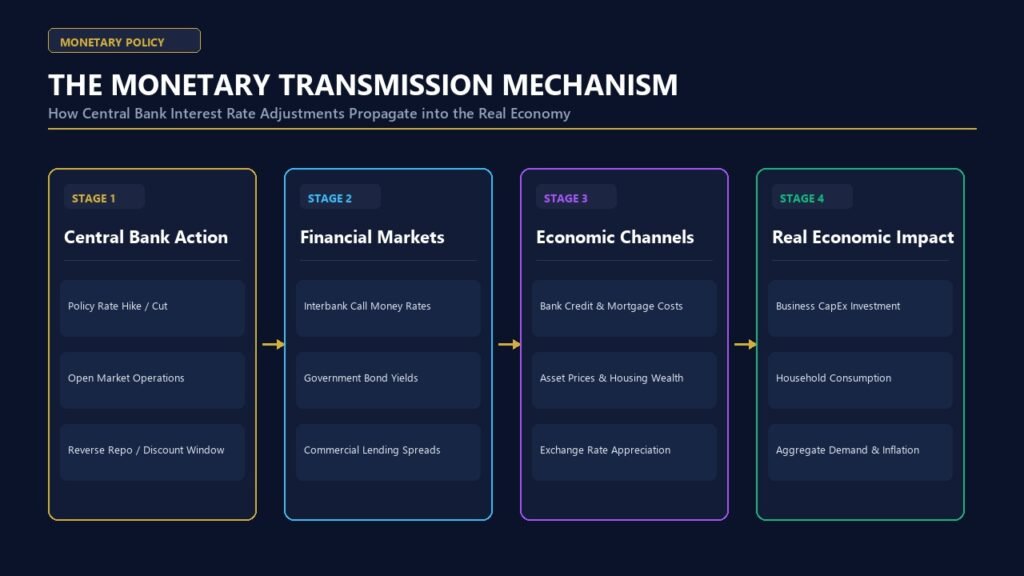
Introduction to the Monetary Transmission Mechanism
When a central bank like the Federal Reserve or the ECB changes its policy interest rate (e.g., the Federal Funds Rate), it does not directly set the prices of goods and services. Instead, the rate change ripples through the financial system and the broader economy through a complex web of channels known as the Monetary Transmission Mechanism.
The Channels of Transmission
- The Interest Rate Channel: The most direct route. Higher central bank rates increase the cost of borrowing for commercial banks, who pass these costs to consumers and businesses. Higher mortgage and corporate loan rates reduce consumption and investment, shrinking Aggregate Demand.
- The Asset Price (Wealth) Channel: Higher interest rates increase the discount rate applied to future corporate cash flows, often causing stock and bond prices to fall. As household wealth declines, consumers spend less (the wealth effect).
- The Exchange Rate Channel: Higher interest rates attract foreign capital seeking yield. This increases demand for the domestic currency, causing it to appreciate. A stronger currency makes exports more expensive and imports cheaper, widening the trade deficit and cooling domestic inflation.
- The Credit (Bank Lending) Channel: Higher rates reduce the net worth of borrowers, increasing agency costs and the risk of default. Banks become more risk-averse and tighten lending standards, reducing credit availability regardless of demand.
Worked Numerical Example: The Impact on Investment (NPV)
Businesses decide to invest in capital projects based on Net Present Value (NPV). $$ NPV = \sum \frac{C_t}{(1+r)^t} – C_0 $$
Assume a firm considers a $100M factory ($C_0$) yielding $10M a year in perpetuity. If the central bank rate causes the corporate borrowing rate ($r$) to be 8%, the present value of the cash flows is $10M / 0.08 = $125M. The NPV is +$25M. The project goes ahead, boosting GDP.
If the central bank hikes rates to fight inflation, pushing the corporate rate to 12%, the PV becomes $10M / 0.12 = $83.3M. The NPV is now -$16.7M. The firm cancels the project, cooling economic activity.
Limitations: “Pushing on a String”
John Maynard Keynes famously noted that while raising rates can effectively cool an overheating economy (pulling the string), lowering rates during a deep recession might not stimulate borrowing if business confidence is shattered. Banks may refuse to lend, and firms may refuse to borrow even at 0% interest, a phenomenon known as the Liquidity Trap.
Frequently Asked Questions
How long does the transmission mechanism take?
Monetary policy operates with “long and variable lags.” Milton Friedman observed it typically takes 12 to 18 months for an interest rate hike to fully impact inflation and employment, making central banking highly anticipatory rather than reactive.
What is the Neutral Rate of Interest (r*)?
The neutral rate (r-star) is the theoretical interest rate that neither stimulates nor restricts the economy. If the policy rate is above r*, policy is restrictive; if below, it is accommodative.