Introduction: The Evolution of Central Banking
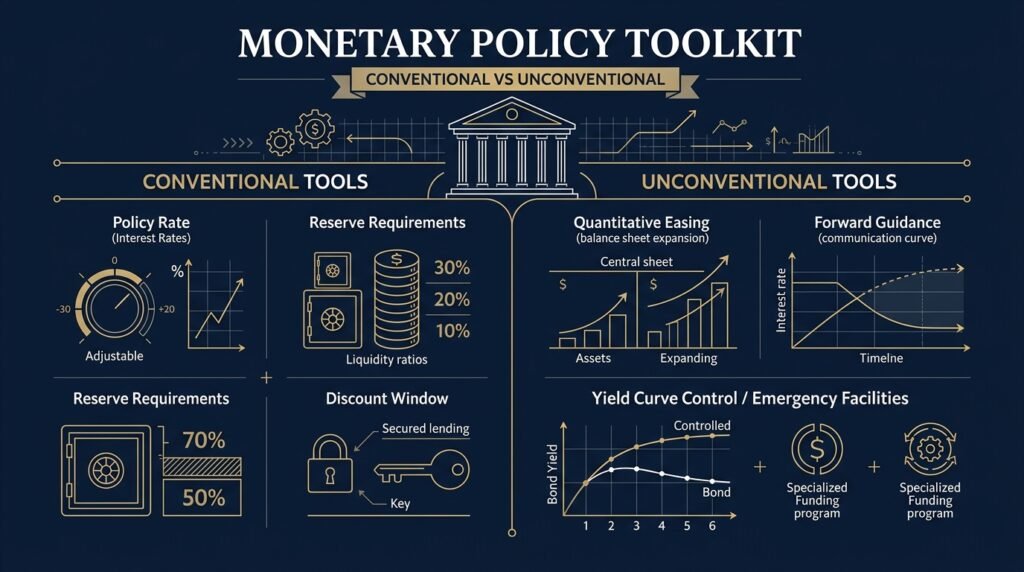
For decades, central banks managed the macroeconomic cycle using a standard, conventional toolkit. However, the 2008 Global Financial Crisis (GFC) forced interest rates to zero, rendering standard tools ineffective. Central banks were forced to innovate, creating a suite of “unconventional” policies that are now permanent fixtures of monetary economics.
Conventional Monetary Policy Tools
- Open Market Operations (OMOs): The traditional buying and selling of short-term government bonds to manipulate bank reserves and steer the overnight interbank lending rate (e.g., the Fed Funds Rate).
- Discount Rate: The interest rate charged to commercial banks for short-term loans directly from the central bank’s discount window, acting as a lender of last resort.
- Reserve Requirements: Mandating the fraction of customer deposits that banks must hold in reserve. Lowering the requirement increases the money multiplier.
The Zero Lower Bound and Unconventional Tools
When conventional rates hit 0% (the Zero Lower Bound), central banks cannot cut rates further without exploring negative interest rates. Thus, they turned to:
- Quantitative Easing (QE): Large-scale asset purchases of long-term securities (government bonds, mortgage-backed securities) to drive down long-term yields.
- Forward Guidance: Explicit public communication regarding the future path of interest rates. By promising to keep rates low for an extended period, central banks can lower long-term yields today.
- Yield Curve Control (YCC): Targeting a specific yield on longer-term bonds and committing to buy whatever amount is necessary to peg the rate (used extensively by the Bank of Japan).
Worked Numerical Example: The Money Multiplier
Under conventional reserve requirements, the theoretical maximum creation of money is governed by the Money Multiplier ($m$): $$ m = \frac{1}{Reserve Ratio} $$
If the central bank sets the reserve requirement at 10% (0.10), a $1,000 injection via OMOs can theoretically expand the money supply by: $$ 1000 \times \frac{1}{0.10} = 10,000 $$
Note: Post-2008, the US shifted to an “ample reserves” regime where banks hold vast excess reserves, making the classic money multiplier less relevant; policy is now controlled via Interest on Reserve Balances (IORB).
Frequently Asked Questions
What are negative interest rates (NIRP)?
Used by the ECB and Bank of Japan, NIRP means commercial banks are charged a fee to park excess reserves at the central bank. The goal is to penalize hoarding and force banks to lend to the real economy.
Why did the Fed drop Reserve Requirements to zero in 2020?
To provide maximum liquidity during the COVID-19 panic, the Fed eliminated reserve requirements. Because the Fed now manages interest rates by paying interest on reserves (IORB), mandatory reserve minimums are no longer necessary for monetary control.