Introduction to Quantitative Easing (QE)
Quantitative Easing (QE) is an unconventional monetary policy where a central bank purchases large quantities of long-term securities from the open market to increase the money supply and encourage lending and investment. Introduced widely during the 2008 Global Financial Crisis, QE is utilized when short-term interest rates are already at zero.
The Mechanics of QE
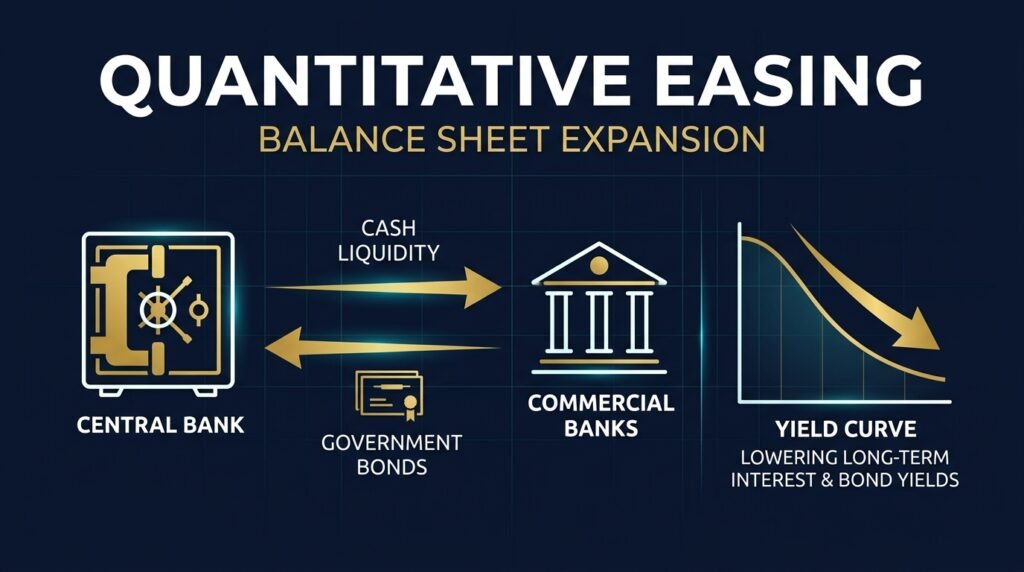
Unlike conventional Open Market Operations that target short-term rates, QE targets the long end of the yield curve. The mechanism works as follows:
- The central bank creates bank reserves digitally out of thin air.
- It uses these reserves to buy long-term government bonds or mortgage-backed securities from commercial banks and institutional investors.
- The massive demand for these bonds pushes their prices up.
- Because bond prices and yields are inversely related, long-term interest rates fall across the economy.
The Portfolio Rebalancing Channel
The primary theoretical driver of QE is the Portfolio Balance Channel. When the central bank buys safe government bonds, it removes duration risk from the market. Investors who sold those bonds now hold cash yielding zero. To achieve their required returns, they are forced to rebalance their portfolios into riskier assets like corporate bonds and equities. This drives down corporate borrowing costs and boosts stock market valuations, creating a wealth effect.
Worked Numerical Example: Bond Pricing and Yields
The price of a perpetual bond paying a fixed coupon is: $$ P = \frac{Coupon}{Yield} $$
Imagine a bond with a $50 annual coupon trading at a yield of 5%. Its price is: $P = 50 / 0.05 = \$1000$.
The central bank announces a massive QE program, buying up these bonds. The surge in demand pushes the market price of the bond up to $1,250. What is the new yield for the broader economy?
$$ Yield = \frac{Coupon}{Price} = \frac{50}{1250} = 4.0\% $$
By driving the price up, the central bank successfully pushed long-term interest rates down from 5% to 4%, making mortgages and business loans cheaper.
Criticisms of Quantitative Easing
QE has faced significant criticism from various economic schools. Austrian economists and Monetarists argue that massive balance sheet expansion dramatically increases the money supply, planting the seeds for future inflation (as seen post-COVID-19). Furthermore, critics highlight that the “portfolio rebalancing” effect disproportionately benefits the wealthy who own financial assets, exacerbating wealth inequality without significantly boosting wage growth.
Frequently Asked Questions
Is QE just “printing money”?
Colloquially, yes, but technically it is an asset swap. The central bank swaps newly created electronic bank reserves for existing government bonds. It changes the composition of assets held by the private sector (less bonds, more reserves) but does not directly hand cash to consumers.
What is Quantitative Tightening (QT)?
QT is the reverse of QE. The central bank stops buying bonds and allows its existing holdings to mature without reinvesting the proceeds, effectively shrinking its balance sheet and removing liquidity from the financial system to fight inflation.