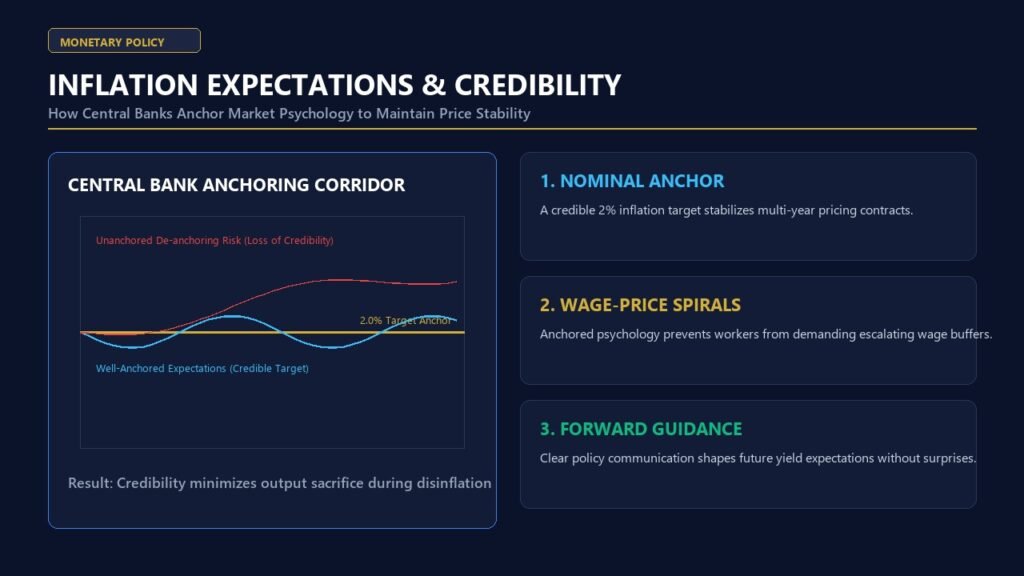
Introduction: The Psychology of Inflation
Modern macroeconomic theory posits that current inflation is heavily driven by what people believe future inflation will be. Inflation expectations are the self-fulfilling psychological anchor of the global price system. The primary job of a modern central bank is not just managing interest rates, but managing the psychology and expectations of the public.
The Wage-Price Spiral
If workers expect inflation to be 5% next year, they will demand a 5% wage increase today to protect their real purchasing power. Businesses, facing a 5% increase in labor costs, will raise their product prices by 5% to protect their profit margins. This creates actual 5% inflation, validating the workers’ expectations and prompting them to ask for even higher wages the following year. This is the dreaded Wage-Price Spiral.
Anchored vs. Unanchored Expectations
Central banks target 2% inflation and strive to keep expectations “anchored” there. If expectations are anchored, temporary supply shocks (like a spike in oil prices) are viewed by the public as transient. Consumers don’t demand massive wage hikes because they trust inflation will return to 2%.
If expectations become “unanchored,” central banks lose control. They are forced to induce massive recessions (like Paul Volcker did in the early 1980s) to crush demand and reset the national psychology.
Mathematical Framework: The Euler Equation
In New Keynesian models, current inflation ($\pi_t$) is a function of the output gap ($x_t$) and discounted expected future inflation ($E_t[\pi_{t+1}]$):
$$ \pi_t = \beta E_t[\pi_{t+1}] + \kappa x_t $$
Where $\beta$ is the discount factor and $\kappa$ measures price stickiness. This equation mathematically proves that if expectations ($E_t[\pi_{t+1}]$) rise, actual current inflation ($\pi_t$) must rise, regardless of the current state of the economy ($x_t$).
How Are Expectations Measured?
- Survey-Based: Asking consumers and businesses directly (e.g., University of Michigan Surveys of Consumers).
- Market-Based (Breakeven Inflation): Subtracting the yield on inflation-protected government bonds (TIPS) from the yield on standard nominal government bonds. If a 10-year Treasury yields 4% and a 10-year TIPS yields 1.5%, the market’s inflation expectation is 2.5%.
Frequently Asked Questions
Why is central bank credibility so important?
Expectations are anchored entirely by credibility. If the public believes a central bank is subservient to politicians and will print money to fund government deficits, they will expect high inflation, causing immediate actual inflation. Independence secures credibility.
Can expectations be too low?
Yes. In Japan, deflationary expectations became deeply entrenched. Consumers expected prices to fall, so they delayed purchases. This lack of demand caused prices to actually fall, creating a self-fulfilling deflationary trap that Japan fought for decades.