
Updated: 17 October 2026, 9:30 AM IST
The IMF World Economic Outlook for October 2026 projects global growth of 3.1% this year, down from 3.5% in 2025, before a rebound to 3.4% in 2027. At the same time, world inflation is forecast to rise to 4.7% in 2026. The International Monetary Fund released the report on 13 October in Bangkok, during the IMF-World Bank Annual Meetings.
That headline sounds calm. However, the report’s own title, “Resilience Under Strain, Urgent Choices”, tells a sharper story. An energy shock from the war in the Middle East is pulling one way, and an AI-driven investment boom is pulling the other. So who wins, who loses, and what should readers watch next?
Table of Contents
The Headline Numbers in One Table
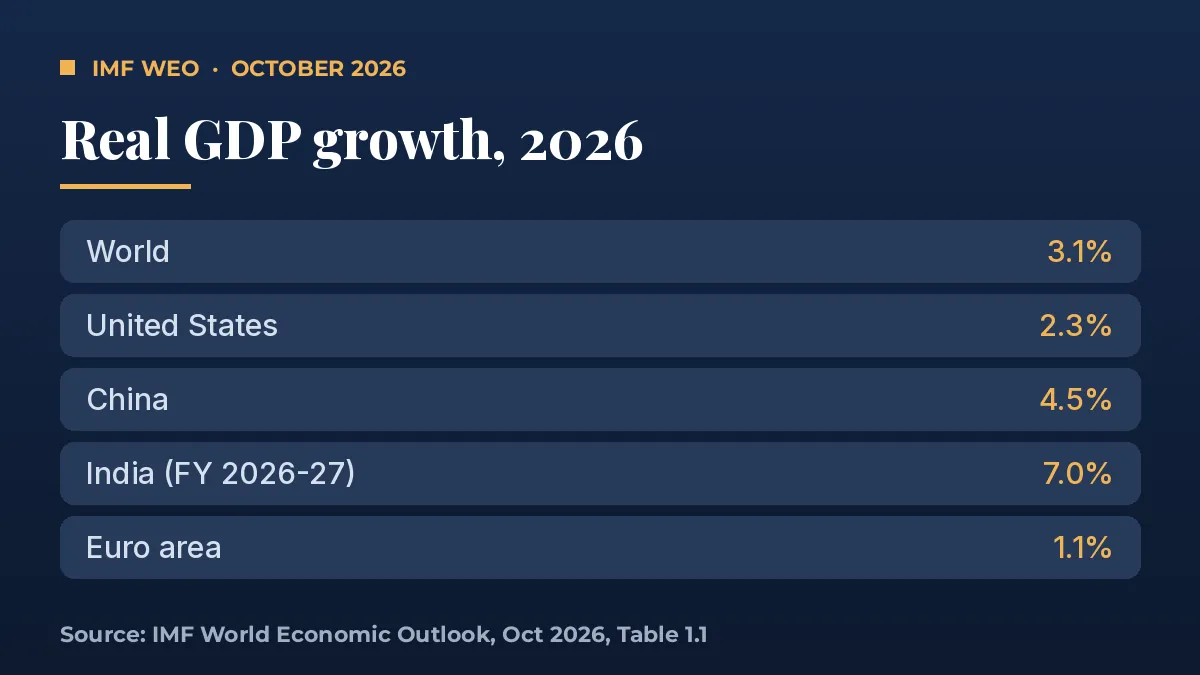
Table 1.1 of the report sets out the IMF baseline. The figures below are annual percentage changes in real GDP, except where noted.
| Economy | 2025 | 2026 (proj.) | 2027 (proj.) |
|---|---|---|---|
| World | 3.5 | 3.1 | 3.4 |
| Advanced economies | 2.0 | 2.1 | 1.8 |
| United States | 2.3 | 2.3 | 2.3 |
| Euro area | 1.2 | 1.1 | 1.2 |
| Japan | 1.2 | 0.7 | 0.7 |
| Emerging market and developing economies | 4.5 | 3.7 | 4.4 |
| China | 5.0 | 4.5 | 4.0 |
| India (fiscal year) | 7.8 | 7.0 | 7.0 |
| Middle East and Central Asia | 3.7 | -0.3 | 6.3 |
| World consumer prices | 4.1 | 4.7 | 4.1 |
Two details stand out. First, the 2026 world forecast is 0.1 percentage point higher than in the July 2026 update, so the IMF is not cutting growth further. Second, the split between regions is unusually wide. The Middle East and Central Asia region is projected to shrink, while India, the United States and the euro area hold steady.
What the IMF World Economic Outlook Says About the Two Big Forces
The October IMF World Economic Outlook describes two forces shaping the year. At the press briefing, IMF Economic Counsellor Silvana Tenreyro called the first one an energy and commodity price shock triggered by the war, which acts like a negative global supply shock. It raises prices and hurts activity at the same time.
The second force is the technology boom, mostly driven by artificial intelligence. It works like a positive demand shock. As a result, it lifts both investment and output, especially in economies that make chips, build data centres or supply the AI value chain.
The balance between these forces explains most of the forecast. Economies inside the technology value chain, or those with favourable terms of trade, are doing relatively well. By contrast, energy importers outside that chain face the hardest outlook, according to the report.
Why Global Inflation Is Rising Again
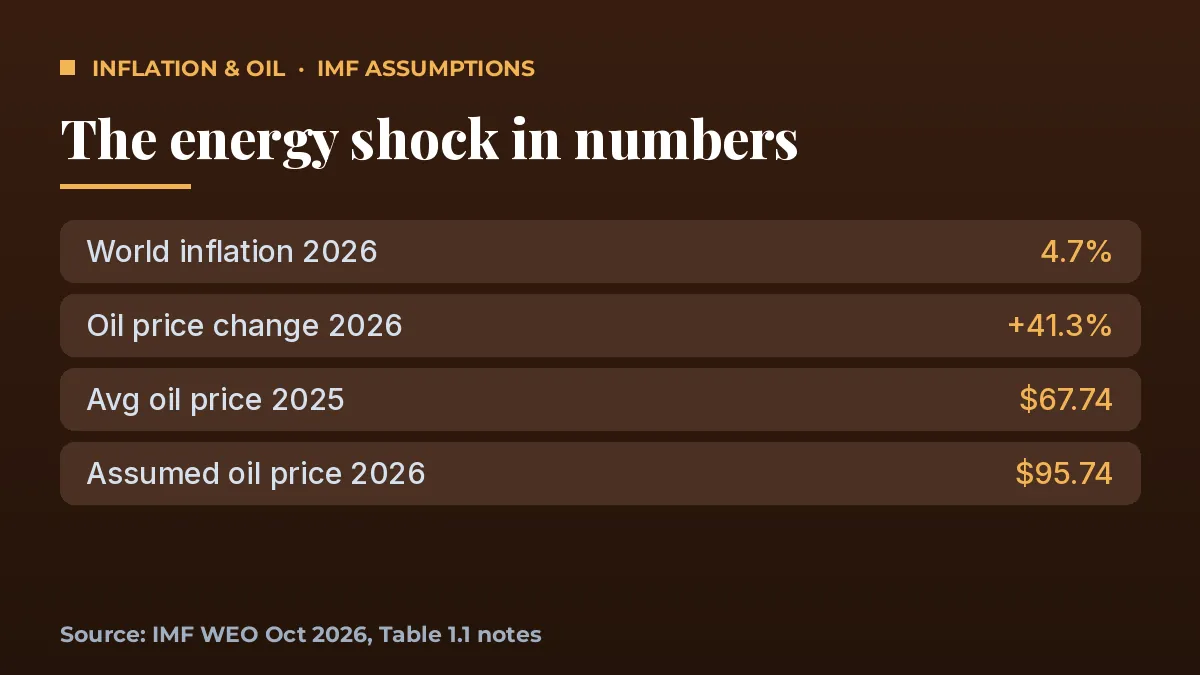
For the first time in several years, the IMF expects global inflation to move up rather than down. World consumer prices are projected to rise 4.7% in 2026, up from 4.1% in 2025, before easing back to 4.1% in 2027.
Oil is the main reason. The report’s commodity assumptions show oil prices rising 41.3% in 2026 after a 14.4% fall in 2025. In dollar terms, the average oil price was $67.74 a barrel in 2025. The futures-based assumption is $95.74 for 2026 and $87.39 for 2027.
Inflation is rising in both groups of countries. In advanced economies, it is projected at 3.1% in 2026, against 2.5% in 2025. In emerging market and developing economies, it rises to 5.7% from 5.2%. In other words, the energy shock is reaching household budgets almost everywhere.
Central banks have already reacted. For example, the Reserve Bank of India said in its 7 October 2026 policy statement that the US Federal Reserve hiked by 25 basis points in September, and the RBI itself raised its repo rate to 5.50%. Readers who want the theory behind this can see our explainer on the structural drivers of global inflation.
Winners and Losers by Region
The regional picture in the IMF World Economic Outlook is a story of divergence.
- United States: Growth is projected at 2.3% in both 2026 and 2027, supported by robust private consumption and fiscal policy, according to the IMF.
- Euro area: Growth eases slightly to 1.1% in 2026. Germany improves to 1.3%, while France slows to 0.4%.
- Japan: Growth slows to 0.7% in 2026 from 1.2% in 2025.
- China: Growth slows to 4.5% in 2026 and 4.0% in 2027. The report cites higher oil prices, prolonged uncertainty and structural headwinds, with policy support preventing a sharper slowdown.
- India: Growth is projected at 7.0% for fiscal year 2026-27, an upward revision of 0.6 percentage point from July. On a calendar-year basis, the IMF projects 7.4% for 2026.
- Middle East and Central Asia: The region is projected to contract by 0.3% in 2026, then rebound by 6.3% in 2027. Saudi Arabia’s output falls 3.3% in 2026 before growing 7.9% in 2027.
India stands out in the report. The IMF links its upward revision to sustained momentum, favourable demographics, a large domestic market and continued structural reforms. Meanwhile, several Southeast Asian economies benefit from data-centre activity and the global technology upturn.
Trade Holds Up Better Than Expected
World trade volume is projected to grow 4.6% in 2026 and 4.7% in 2027, after 5.0% in 2025. That is 1.1 percentage points higher for 2026 than the July update. Imports of advanced economies are projected to rise 5.0% in 2026, up from 4.7% in 2025.
This resilience matters because trade shocks usually spread fast through supply chains. Our guide to how trade shocks transmit into inflation explains the mechanics. For now, the IMF data suggest supply chains are adapting rather than breaking.
The Fiscal Warning in Chapters 2 and 3
The report’s analytical chapters carry a clear message for finance ministers. Chapter 2 studies cost-of-living crises, when food and energy prices jump and purchasing power falls. It finds that targeted, temporary cash transfers protect vulnerable households most effectively.
By contrast, measures that suppress prices, such as broad fuel subsidies or price caps, can require 3 to 22 times more fiscal resources. They may also stop working when fiscal space is limited or when many countries adopt them at once.
Chapter 3 looks at corporate income tax. It finds that debt-financed tax cuts support domestic activity but can create negative spillovers abroad in the short term. Over time, lower revenue can squeeze public investment, especially in emerging economies. That links neatly to our analysis of the Laffer curve and tax revenue.
Five Risks Flagged in the October Report
The IMF says risks to global growth are tilted to the downside. Chapter 1 highlights the threats below, along with two upside possibilities.
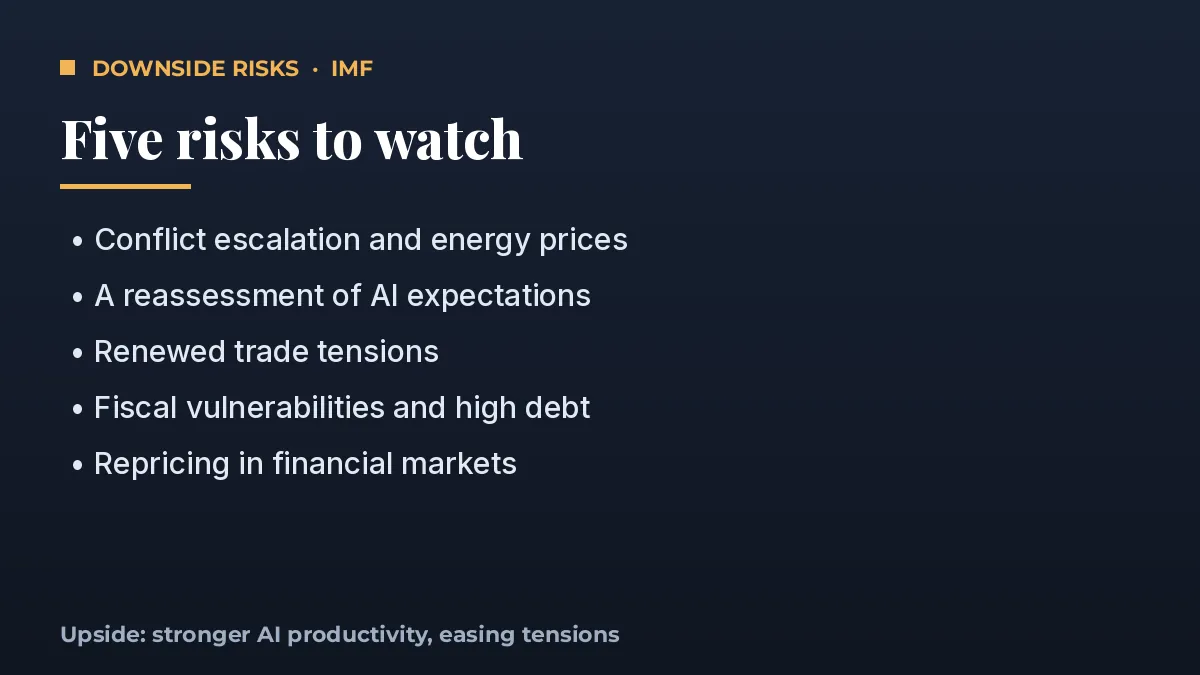
- Conflict escalation: A wider war could keep energy prices higher and more volatile for longer.
- An AI reassessment: If expectations about artificial intelligence are revised down, investment and stock valuations could fall sharply.
- Renewed trade tensions: New tariffs or restrictions would hit the trade resilience seen so far.
- Fiscal vulnerabilities: High public debt and rising bond yields reduce room to respond to the next shock.
- Financial repricing: Tighter financial conditions could expose weak borrowers.
On the upside, stronger AI investment and productivity gains, or a lasting easing of geopolitical and trade tensions, could lift growth above the baseline. Our explainer on sovereign debt and high interest rates covers the fiscal risk in more depth.
Five Insights From the IMF World Economic Outlook
- Resilience is real but uneven. The 3.1% world figure hides a wide gap between technology winners and energy importers.
- Inflation is back on the agenda. A rise to 4.7% means central banks are tightening, not easing.
- Oil is the swing factor. The forecast assumes energy markets gradually normalise; if they do not, growth is weaker.
- India is the bright spot among large economies. Its 7.0% fiscal-year projection was revised up.
- Policy choices matter. Targeted support is far cheaper than blanket price controls.
What Happens Next
The next full edition of the IMF World Economic Outlook is due in April 2027, with an interim update in January. Until then, three indicators will show whether the baseline holds: the oil price against the $95.74 assumption, monthly inflation prints in major economies, and investment spending on AI. In short, the October 2026 report is a warning that resilience has a cost, and that the margins for error are getting thinner.
Frequently Asked Questions
What is the IMF World Economic Outlook global growth forecast for 2026?
The October 2026 edition projects global growth of 3.1% in 2026, down from 3.5% in 2025, and 3.4% in 2027. The forecast assumes the Middle East conflict does not escalate further and that energy markets gradually return to normal.
What is the IMF’s growth forecast for India?
The IMF projects India’s growth at 7.0% for fiscal year 2026-27 and 7.0% for 2027-28. That is 0.6 percentage point higher than its July estimate. On a calendar-year basis, it projects 7.4% for 2026 and 7.0% for 2027.
Why does the IMF expect inflation to rise in 2026?
Mainly because of higher energy and food prices linked to the war in the Middle East. The IMF assumes oil prices rise 41.3% in 2026. As a result, world inflation is projected at 4.7%, before easing to 4.1% in 2027.
How often is the World Economic Outlook published?
The full report is published twice a year, usually in April and October, ahead of IMF meetings. Shorter updates with revised growth projections for selected economies are released in January and July, according to the IMF’s WEO frequently asked questions page.
Sources
- IMF: World Economic Outlook, October 2026, Resilience Under Strain, Urgent Choices
- IMF: World Economic Outlook frequently asked questions
- IMF Media Center: WEO press briefing, 13 October 2026
- RBI: Monetary Policy Committee resolution, 7 October 2026
How we verified: all projections are taken from Table 1.1 and Chapter 1 of the October 2026 World Economic Outlook. Figures are IMF staff projections and will be revised. This article is analysis, not investment advice.