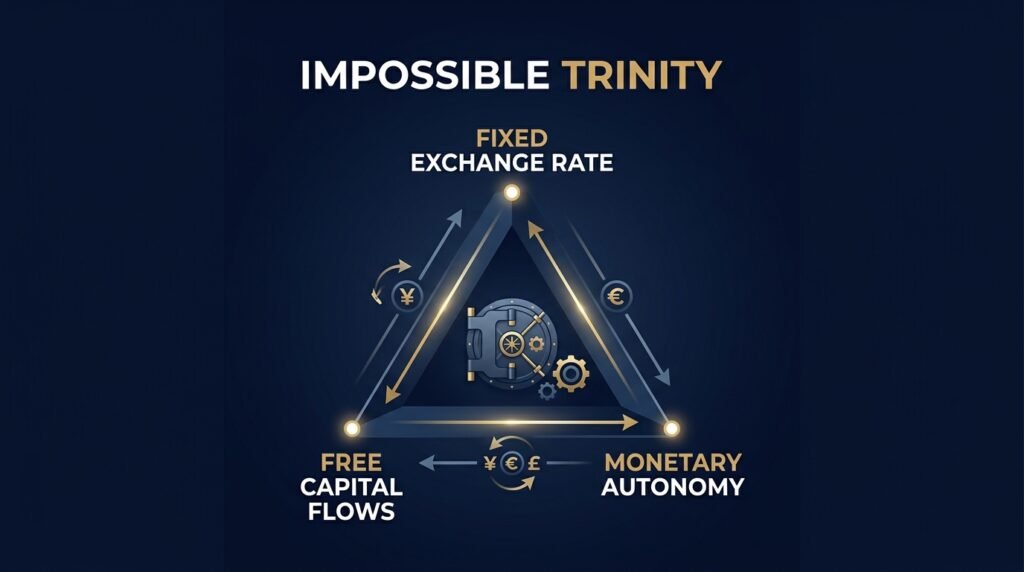
In international macroeconomics, few principles are as unyielding or consequential as the Impossible Trinity. Also known as the Mundell-Fleming Trilemma, this foundational macroeconomic theorem states that an economy cannot simultaneously achieve three policy objectives: a fixed (pegged) foreign exchange rate, free international capital mobility, and an independent sovereign monetary policy. A central bank can choose any two of these goals, but it must inevitably abandon the third.
Formulated independently in the early 1960s by Canadian economist Robert Mundell and Scottish economist J. Marcus Fleming, the Impossible Trinity explains why currency crises erupt, why exchange rate pegs collapse, and why modern central banks face severe constraints in an interconnected financial architecture. From the breakdown of the Bretton Woods system in 1971 to the UK’s “Black Wednesday” in 1992 and the 1997 Asian Financial Crisis, historical episodes have repeatedly demonstrated that governments cannot defy the laws of international arbitrage.
This comprehensive guide explores the theoretical origins of the Impossible Trinity, examines the three policy vertices of the trilemma, explains the mathematical mechanisms that enforce the trade-off, analyzes how real-world economies choose between the three regimes, and evaluates modern challenges such as the Global Financial Cycle.
1. The Three Policy Objectives Explained
To understand why the trilemma is binding, one must first examine why sovereign governments desire each of the three policy vertices:
A. A Fixed (Pegged) Exchange Rate
A fixed exchange rate pegs the national currency to an anchor currency (such as the U.S. dollar or euro) or to a basket of currencies. The primary appeal of exchange rate stability is the elimination of currency risk. When exchange rates are predictable, international trade flourishes, cross-border contracts are transparent, and domestic firms can import capital equipment without hedging against sudden foreign exchange depreciation. For developing economies, pegging to a stable global currency also serves as a nominal anchor against hyperinflation.
B. Free International Capital Mobility
Free capital mobility means money moves across borders without regulatory frictions or capital controls. Open capital markets allow domestic businesses to access global investment capital at lower borrowing costs, attract foreign direct investment (FDI), and enable domestic savers to diversify across international assets. In modern financial architecture, free capital movement is a hallmark of global integration.
C. Sovereign Monetary Policy Autonomy
Monetary autonomy is the ability of a central bank to set domestic policy rates, regulate credit, and adjust money supply to stabilize its own business cycle. When an economy enters a recession, monetary autonomy allows the central bank to slash interest rates to stimulate investment and employment. When inflation accelerates, the central bank can hike rates—as prescribed by systematic frameworks like the Taylor Rule—to cool aggregate demand without foreign constraints.
2. The Economic Mechanism: Why You Cannot Have All Three
Why is it impossible to achieve all three goals simultaneously? The answer lies in the fundamental pricing mechanism of open-economy macroeconomics: Uncovered Interest Rate Parity (UIP) and balance of payments arbitrage.
Under free capital mobility, global capital flows rapidly across borders seeking the highest risk-adjusted yield. The relationship governing international interest rates and exchange rates is expressed as:
i = i* + ΔEe / E
Where:
- i: Domestic nominal interest rate.
- i*: Foreign (world) nominal interest rate.
- ΔEe / E: The expected percentage change (depreciation or appreciation) of the exchange rate over the investment horizon.
Now consider what happens if a government commits to a fixed exchange rate. If the peg is credible, market participants expect zero exchange rate change (ΔEe / E = 0). Substituting this into the interest parity equation produces an absolute constraint:
i = i*
This simple equality reveals the entire trap of the Impossible Trinity. If a country maintains a fixed exchange rate and allows capital to flow freely, its domestic interest rate must equal the foreign interest rate. The domestic central bank has completely surrendered its monetary autonomy.
What Happens If a Central Bank Tries to Defy the Parity?
Suppose a country maintains a fixed exchange rate to the U.S. dollar and allows free capital flows, but its domestic economy falls into a recession. The central bank attempts to exercise monetary autonomy by slashing domestic interest rates from 5.0% to 2.0% while U.S. interest rates remain at 5.0%.
Because capital is free to move, global investors and domestic depositors will not accept a 2.0% return when they can earn 5.0% in dollar-denominated assets with zero currency risk. A massive capital flight begins immediately:
- Investors sell domestic bonds, convert domestic currency into U.S. dollars, and transfer capital abroad.
- The selling of domestic currency creates overwhelming downward pressure on the pegged exchange rate.
- To defend the peg, the central bank must sell foreign exchange reserves (U.S. dollars) and buy back domestic currency.
- As the central bank absorbs domestic currency, commercial bank liquidity shrinks. To attract scarce deposits, commercial banks raise interest rates back up to 5.0%.
The rate cut is neutralized. If the central bank refuses to allow domestic rates to rise, it will rapidly exhaust its foreign exchange reserves, forcing an abandonment of the peg and a sudden currency collapse.
3. The Three Sides of the Trilemma: Real-World Archetypes
Because an economy cannot sit at the center of the triangle, it must position itself along one of its three distinct sides:
Side 1: Fixed Exchange Rate + Free Capital Mobility (Abandon Monetary Autonomy)
Under this regime, an economy secures exchange rate stability and access to global capital, but forfeits independent monetary policy.
- The Eurozone Member States: Countries like Germany, France, and Italy share a single currency with unrestricted capital mobility. However, no individual member nation has its own central bank or interest rate. If Italy suffers a regional recession while Germany is overheating, Italy cannot cut interest rates; it must accept the rate set by the European Central Bank (ECB) for the bloc as a whole.
- The Hong Kong Currency Board: Since 1983, the Hong Kong dollar has been pegged to the U.S. dollar within a tight band of HK$7.75 to HK$7.85 per USD. With zero capital controls, the Hong Kong Monetary Authority (HKMA) must mechanically replicate the Federal Reserve’s interest rate hikes and cuts, regardless of whether Hong Kong’s local real estate market or economy requires tighter or looser policy.
Side 2: Free Capital Mobility + Monetary Autonomy (Abandon Fixed Exchange Rates)
This is the standard regime adopted by major advanced economies. Under this framework, the central bank sets interest rates according to domestic economic priorities, capital moves freely, and the exchange rate floats according to market supply and demand.
- The United States, United Kingdom, and Japan: The Federal Reserve, the Bank of England, and the Bank of Japan set interest rates to stabilize domestic employment and inflation. When the Federal Reserve raises rates while the Bank of Japan maintains low rates, the exchange rate absorbs the pressure through currency movements (such as sharp yen depreciation). The exchange rate acts as a shock absorber rather than an operational anchor.
Side 3: Fixed Exchange Rate + Monetary Autonomy (Abandon Free Capital Mobility)
Under this regime, a country maintains exchange rate stability while preserving independent monetary policy by building a regulatory wall through capital controls.
- The Bretton Woods System (1944–1971): The global monetary order established at Bretton Woods fixed global currencies to the U.S. dollar. The system relied on extensive capital controls, allowing nations to manage domestic employment without triggering speculative capital runs.
- China’s Approach: For decades, the People’s Bank of China (PBOC) pegged the renminbi (RMB) to the U.S. dollar while setting domestic interest rates suited for domestic growth. This was made possible strictly by capital account restrictions, such as limits on cross-border wire transfers and foreign exchange quotas. As explored in our analysis of how China Is Trapped in Deflation, managing balance sheet adjustments behind capital controls creates unique domestic macro risks.
4. Comparative Framework Summary
| Policy Archetype | Fixed Exchange Rate | Free Capital Flows | Monetary Autonomy | Sacrificed Objective | Notable Real-World Examples |
|---|---|---|---|---|---|
| Side A (Open Peg) | YES | YES | NO | Monetary Autonomy | Eurozone member states, Hong Kong Currency Board, Denmark |
| Side B (Floating Autonomy) | NO | YES | YES | Fixed Exchange Rate | United States, Eurozone (as a whole), Japan, United Kingdom, Australia |
| Side C (Closed Peg) | YES | NO | YES | Free Capital Mobility | Bretton Woods (1944–1971), China (historically), Malaysia (1998 post-crisis) |
5. When Economies Try to Defy the Trilemma: Historic Currency Crises
Economic history is filled with crises triggered by governments that attempted to sit in the middle of the Impossible Trinity—promising a fixed exchange rate, opening capital accounts, and simultaneously pursuing an independent domestic monetary policy.
The 1992 UK “Black Wednesday” Crisis
In 1990, the United Kingdom joined the European Exchange Rate Mechanism (ERM), pegging the British pound to the German mark with open capital markets. Following German reunification, the Bundesbank hiked interest rates to combat domestic inflation, while Britain was in a deep recession. The Bank of England needed to cut rates, but the ERM peg required matching high German rates. Recognizing Britain could not politically sustain punitive rates, speculators (led by George Soros) shorted the pound. On September 16, 1992 (“Black Wednesday”), after exhausting billions in reserves, the UK exited the ERM, let the pound float, and restored monetary independence.
The 1997 Asian Financial Crisis
Throughout the early 1990s, Thailand, Indonesia, and South Korea pegged their domestic currencies to the U.S. dollar while liberalizing their capital accounts, attracting vast foreign short-term debt. When the Federal Reserve raised rates in the mid-1990s and the dollar strengthened, Asian exports lost competitiveness. Investors realized regional banks held immense short-term foreign debt backed by dwindling reserves. Capital rapidly reversed. Thailand defended the baht’s peg until reserves were depleted in July 1997. The peg broke, the baht plummeted, and contagion swept across Asia, forcing emergency assistance from the International Monetary Fund (IMF).
6. Modern Emerging Markets and the “Dilemma” Hypothesis
In recent years, the classic trilemma has been extended by research from London Business School economist Hélène Rey. In her 2013 paper, “Dilemma not Trilemma: The Global Financial Cycle and Monetary Policy Independence,” Rey argued that in an era of massive capital flows dominated by the Federal Reserve, independent monetary policy is constrained for open economies regardless of exchange rate regime.
When the Federal Reserve eases policy, global liquidity surges into emerging markets, inflating asset prices. When the Fed tightens, capital abruptly exits, depreciating currencies and freezing credit. Rey argues the trilemma has collapsed into a Dilemma: an economy can maintain monetary autonomy only by regulating its capital account, whether its currency floats or not.
How Emerging Markets Navigate the Trade-off: The Managed Middle
Rather than choosing an extreme corner, modern emerging market central banks—such as the Reserve Bank of India (RBI)—pursue a pragmatic “managed middle ground”:
- Managed Floating Currency: They allow currencies to float over the long run, but intervene actively in spot and forward markets to prevent disorderly shocks.
- Massive FX Reserve Buffers: Accumulating vast foreign exchange reserves provides a defensive buffer during capital flight, as analyzed in our study on RBI’s Rate Turn: How Oil, the Fed and a Rupee Past 96 Cornered India’s Central Bank.
- Macroprudential Regulations: Deploying targeted capital flow management measures—such as limits on foreign portfolio debt and external borrowing caps—dampens speculative swings without closing the capital account.
7. Frequently Asked Questions (FAQ)
Can a country temporarily achieve all three goals of the Impossible Trinity?
Only in the short run and at high cost. A central bank can use existing foreign exchange reserves to defend a peg while setting rates below foreign levels. However, as reserves are finite, arbitrageurs will rapidly drain reserves, forcing a sharper currency devaluation.
Why did Eurozone nations give up monetary autonomy?
European policymakers believed eliminating exchange rate risk across the Single Market would spur cross-border investment and remove trade frictions. However, the Eurozone debt crisis demonstrated that relinquishing monetary autonomy creates structural vulnerabilities when member states experience asymmetrical shocks.
What is the difference between the Impossible Trinity and the Trilemma?
The terms are used interchangeably. “Mundell-Fleming Model” refers to the underlying economic theory, “Impossible Trinity” describes the three incompatible goals, and “Trilemma” describes the three-way policy choice facing macroeconomic authorities.
8. Practical Takeaways for Students, Investors, and Policymakers
- No Free Lunches in Macroeconomics: Promising exchange rate stability, open financial borders, and sovereign monetary policy is a mathematical impossibility.
- Currency Pegs Carry Hidden Risks: Fixed exchange rates provide temporary stability, but transform currency volatility into banking or debt crises when capital flows reverse.
- Global Financial Spillovers Are Powerful: Because the U.S. dollar is the world’s primary reserve currency, decisions made by the Federal Reserve transmit shockwaves through every central bank’s policy trade-offs.
- An Indispensable Analytical Framework: More than six decades after its inception, the Impossible Trinity remains the essential model for analyzing international currency markets, sovereign risk, and central bank strategy.
References and Authoritative Literature
- Mundell, Robert A. (1963). “Capital Mobility and Stabilization Policy under Fixed and Flexible Exchange Rates.” Canadian Journal of Economics and Political Science, Vol. 29, No. 4, pp. 475–485.
- Fleming, J. Marcus (1962). “Domestic Financial Policies Under Fixed and Under Floating Exchange Rates.” IMF Staff Papers, Vol. 9, No. 3, pp. 369–380.
- Obstfeld, Maurice, Jay C. Shambaugh, and Alan M. Taylor (2005). “The Trilemma in History: Tradeoffs Among Exchange Rates, Monetary Independence, and Capital Mobility.” Review of Economics and Statistics, Vol. 87, No. 3, pp. 423–438.
- Rey, Hélène (2013). “Dilemma not Trilemma: The Global Financial Cycle and Monetary Policy Independence.” Proceedings of the Federal Reserve Bank of Kansas City Economic Policy Symposium, Jackson Hole, pp. 285–333.
- Krugman, Paul R. (1979). “A Model of Balance-of-Payments Crises.” Journal of Money, Credit and Banking, Vol. 11, No. 3, pp. 311–325.
- Bank for International Settlements (BIS). “Foreign Exchange Market Interventions and Global Liquidity.” Available via bis.org.
- International Monetary Fund (IMF). “The Liberalization and Management of Capital Flows: An Institutional View.” Available via imf.org.